Showing posts with label Book of the Month. Show all posts

February 18, 2016

Book Review: Mormonism and American Politics


Mormonism and American Politics. Edited by Randall Balmer and Jana Riess. 264 pp. New York: Columbia University Press, 2015. $30.

Reviewed by Brenna Keegan

Mormonism and American Politics begins with the simple claim, “The story of Mormonism in America is inextricably tied to politics” (ix). Thirteen insightful case studies, written by some of the top Mormon studies scholars, persuasively argue the truth of this statement. Randall Balmer and Jana Riess’ edited volume moves beyond the familiar story of Mormons as political outsiders and gives voice to diverse political discourses.  Structured chronologically, Mormonism and American Politics is bookended by Joseph Smith’s 1844 campaign for president and an analysis of Mitt Romney’s 2012 campaign. The pages within highlight the protean history of Mormon isolation and participation in national politics and American exceptionalism, the politics of polygamy, Mormon race relations, and the Church of Jesus Christ of Latter-day Saints’ stalwart participation in the twentieth-century Republican Party.
The volume offers concise examples of Mormonism’s distinct and extensive participation in American politics. It complicates a narrative of gradual assimilation and the increasingly common project of comparing Mormon history with that of American Catholicism. One of the most compelling chapters, “On the ‘Underground’: What the Mormon ‘Yes on 8’ Campaign Reveals About the Future of Mormons in American Political Life,” by Joanna Brooks, highlights the internal conflicts of supporting anti-LGBT legislation and the distinctive theological stance of Mormon support for California’s Proposition 8.
Although Mormon women may not have historically played a strong public role in American politics, their absence from the volume is apparent. A strong chapter by Jana Riess looks at the nineteenth-century Cult of True Womanhood and Protestant women’s protest against Congressman-elect and polygamist B. H. Roberts, but Claudia L. Bushman’s “Mormon Women Talk Politics,” is an odd amalgamation of songs and personal reflection, with little scholarly analysis.
As one might expect, Mormonism and American Politics spends a substantial amount of time considering the legacy and influence of George and Mitt Romney. “Like Father, Unlike Son: The Governor’s Romney, the Kennedy Paradigm, and the Mormon Question” by Randall Balmer and “Mitt, Mormonism and the Media: An Unfamiliar Faith Takes the Stage in the 2012 U.S. Presidential Election” by Peggy Fletcher Stack, add depth and breadth to the debate.

Of particular interest to this blog is the volume’s treatment of Mormonism not solely, or even primarily, as a religious anomaly of the American West, but an active participant in national politics and history. As Philip Barlow rightly notes, “The religion’s infancy was harbored in the nation’s adolescence; both took form together” (109). Well-researched, with short and concise chapters from a distinguished team of scholars, Mormonism and American Politics does not offer a definitive history, but begins the conversation in stride.

October 23, 2014

Book of the Month: Review of David Silverman's Red Brethren: The Brothertown and Stockbridge Indians and the Problem of Race in Early America


Review by Matthew W. Dougherty


David J. Silverman Red Brethren: The Brothertown and Stockbridge Indians and the Problem of Race in Early America (Ithaca, NY: Cornell University Press, 2010)


David J. Silverman’s Red Brethren follows two multi-tribal American Indian communities—the Brothertowns and the Stockbridges— whose westward migrations reveal new facets of religion and race in early America. Silverman argues that these communities used Protestant categories and concepts both to make sense of the racial identity assigned to them in early America and to propel themselves from New England to New York to Wisconsin. Like white Americans, they migrated for complex reasons: Federal pressure to sell their land and encroaching white settlement contributed, but so did their desire to form autonomous Christian communities and missionize “heathen” American Indians. Silverman thus contributes to the story of the west by showing that white Americans were not the only ones who migrated because of a belief in their particular divine mission. Although his view of the churches at the hearts of these communities grows fuzzier along the journey west, his tightly-focused narrative retains its power throughout the book.

The shared history of the Brothertowns and Stockbridges began in the 1770s and 1780s when Christian Indians from a number of northeastern tribes settled in two new communities—Brothertown and New Stockbridge—in Oneida territory. The move west was made in the hope that the new towns would be stable bases for cultural survival and missions to their “red brethren” in non-Christian tribes. Silverman argues that the Brothertowns’ and Stockbridges’ belief that they had something basic in common with non-Christian Iroquois indicates that they accepted the racial designation of “Indian,” yet attached their own meanings to it. They believed, for example, that the racial oppression they suffered resulted from of God’s curse for their ancestors’ disobedience of the commandments, and would end when divine justice was satisfied. But their acceptance and modification of the prevailing racial category of “Indian” was not without cost: Stockbridges and Brothertowns who married African-Americans were often excluded from the tribe and claims on tribal land. That internal division grew stronger as the communities moved farther west in the 1820s. Hoping that another move would provide more security from white settlers and another chance at evangelism, the Brothertowns and Stockbridges negotiated a treaty with the Menominee to allow them to settle along the Fox River in Wisconsin. In 1831, however, pressure from the U.S. government and tensions with the Menominee forced them to move yet again, this time to the shore of Lake Winnebago. Fearing that further land cessions would be forced on them unless they made a radical change, the Brothertown voted to abandon tribal status and become U.S. Citizens in 1839. The Stockbridge followed suit in 1843, but “gave back” their citizenship and resumed tribal governance only three years later. Silverman argues that disputes over citizenship in these communities were also disputes about race. Both those opposed to the idea and those in favor of it referred to taking citizenship as “becoming white” and saw it as an abandonment of legal Indian identity, for better or worse. These issues still haunt the Brothertowns, whose petition for federal recognition was denied by the Bureau of Indian Affairs in 2012 on the basis that their acceptance of citizenship in 1839 had put an end to their tribal identity.
   
Silverman is fortunate in that the Brothertowns and Stockbridges created an unusually large paper trail. In addition to missionary and government sources, he can draw on the writings of prominent leaders from both communities and on tribal government documents. For the eighteenth and early nineteenth centuries, the copious writings of Brothertown’s founder, Samson Occum, are his main source. After Occum’s death, the paper trail goes on but its character changes: As he follows the story of the Brothertowns and Stockbridges to Wisconsin, Silverman relies more and more frequently on the records of both the tribal and U.S. governments, and has fewer first-person accounts. His choice to focus throughout on the religious and racial self-awareness of community leaders minimizes the shock of the transition, but the loss of Occum as a voluminous, reflective writer and vivid witness does make the latter part of the narrative less immediate and clear-cut.

Silverman’s narrative relies on the category of “Christian Indians” to designate the various Native groups that define themselves at least partly through Christianity in his story. That category fails him, however, in the final chapters of the book. So long as he focuses on New England, the dominance of independent, “New Light” Congregational churches in Christian Native communities ensures that the category “Christian Indian” designates a related set of approaches to religion and community life. As Silverman and other scholars such as Joanna Brooks, Rachel Wheeler, and Linford Fisher have shown, Native-led Congregational churches in New England were in contact with one another, circulated ideas and people, and had distinctive approaches to preserving Native traditions through Christian practice. After the Brothertowns and Stockbridges moved to Wisconsin, however, Baptist and Methodist churches began appearing in their communities, presumably undermining any sense of a unified Christian Indian identity. Silverman’s portrays the development of these separate churches as another sad sign of factionalism (200-202), but doesn’t address how changes in church fellowship and theology might have affected what it meant to be a Christian Indian. For example, did membership in the strongly hierarchical Methodist church constrain Native autonomy more than membership churches governed at the level of the congregation? Did the racial theory of the “curse of God” survive in congregations that moved away from the Reformed theology and Providential view of history underwriting it?  

The fact that we can now ask these questions these about independent Native churches in the west, however, is entirely thanks to Silverman’s groundbreaking work. With careful scholarship and a strong ear for narrative, he has brought to life a story that not only casts light on two remarkable groups whose history challenges many widely-held ideas about American Indian identity, but also persistently and clearly exposes the fault-lines in racial thinking in early America. The re-casting of our stories from the west has brought home the importance of empire, land, and migration as themes in American religious history. Silverman’s book provides a new way of thinking about these themes with a clear, affecting narrative suitable for advanced undergraduates as well as graduate students.

February 3, 2014

Book of the Month:


Robert L. Dorman. Hell of a Vision: Regionalism and the Modern American West. Tucson: University of Arizona Press, 2012.

reviewed by Brett Hendrickson

There are two continua at play in Robert Dorman’s fascinating study of how the West has been perceived and handled over the past century and a half. The first and most prominent of these continua, found in the subtitle of the book, is the tension between regionalism and national unity. The second is the long-running debate about what land in the West can and should do: new frontier of agricultural and industrial paradise or unique setting of magnificent and virgin landscapes that are already spoken for by nature, by Indians, or by “authentic westerners.” The author does a wonderful job of allowing the story of the American West to move to and fro on these continua, and the reader can enjoy the sparks that fly when competing claims and ideas for the region and for the nation scrape against one another.

The question of regionalism is begged when one talks about the American West, and the cast of characters Dorman depicts in his book know this. From John Wesley Powell’s vision of a managed settlement of the West, to the Bureau of Indian Affair’s assimilationist manipulations of Native Americans, to Edward Abbey’s radical and environmental isolationism, to the Sierra Club’s paradoxical plea that the West be saved as a common and nation-wide heritage, it has long been up for debate how much the West should be known as its own special place, or if it should be known as an integral extension of the rest of the country. To complicate this debate about identity, the regionalism of the West has so often broken down into more and more minute expressions of localism, often going far beyond the typical divisions of Pacific Northwest, California, Mormon Country, Great Basin, Rocky Mountains, Southwest, Plains, and Texas.

Tensions about use of the West are tied to the question of region vs. nation. The anti-regionalists, to over-simplify Dorman’s fine analysis, want the area to be planned, tilled, ranched, mined, and managed as part of the national project. An example of this that Dorman discusses is historian Karl Wittfogel’s fear that the exploited, nationalized West could become a despotic “hydraulic society” that depended on “centralized works of water control.” The regionalists, who often include Native American groups as well as Mexican Americans, not to mention Western exceptionalists like Wallace Stegner, Willa Cather, and Earth First!, remind the would be exploiters and national project builders that the region cannot be made in the image of the East. The Dust Bowl, the poverty of reservations, and the contentious localism within the region itself make their point abundantly clear.

Another fascinating and provocative point that Dorman makes has to do with academic fashions and the notion of region. Take these examples:

[The regionalists’] cardinal sin was to attempt to define the regional characteristics of the West (aridity, wide-open spaces, predominant federal ownership of land, etc.). To do so was to “essentialize” the West—to fix its characteristics as a given, an essence—which to the postmodern, poststructuralist mindset of the 1990s was the gravest of scholarly errors....Historian Virginia Scharff declared that to “claim any object, idea, place, process, or people for the category ‘West’ is to fix things, thoughts, and social processes, and lives that are, historically, only contingently, contradictorily, and discontinuously Western” (176-7).

The opposing view:

Other scholars begged to differ with this assessment of regionalism, continuing to find it a potent source of cultural radicalism. Conceptually, their focus was on the subregional localist West....Regionalism was therefore “an alternative and oppositional tradition, one that worked against the construction of nation and empire and that challenged the construction of masculine and feminine that underwrote the projects of nation and empire” (177-8).

Readers of this blog will not be surprised to hear that religion is barely mentioned in Dorman’s book. But one does not need to try very hard to apply Dorman’s observations about regionalism and its discontents to the study of religion in the West. This reader was inspired by Dorman’s book to think more about questions of regional religious study vis-Ă -vis the study of religion in all of North America. We know that regionalists tell stories that complicate nationalist myths. But we also know that regionalists can reify localist myths. That’s why we keep working and why books like Dorman’s are so helpful.

June 4, 2013

Book of the Month

Lee Gilmore, Theater in a Crowded Fire: Ritual and Spirituality at Burning Man (Berkeley: University of California Press, 2010) + DVD. 

Review by Dusty Hoesly


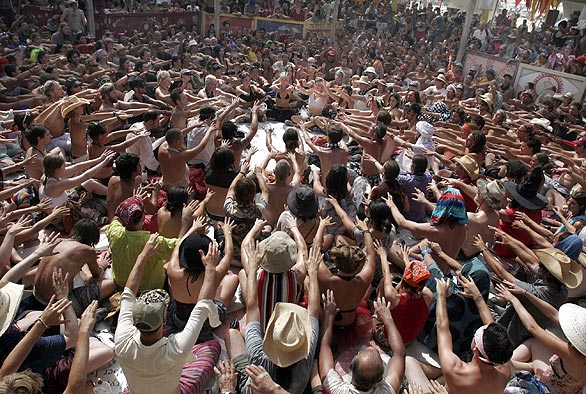
Lee Gilmore’s excellent Theater in a Crowded Fire: Ritual and Spirituality at Burning Man focuses on why so many Burners, as participants call themselves, find the countercultural festival to be culturally and personally significant. Gilmore combines ethnographic fieldwork (based on over a decade of attendance as well as official participation on its Media Team), interviews, surveys, and media reports into a multidisciplinary analysis of religiosity on the playa.

Evolving from a spontaneous effigy-burning on a beach near San Francisco, Burning Man has become a highly organized corporation which manages the annual temporary encampment at Black Rock City in northern Nevada, attracting people from California and around the world. It is a haven and a catalyst for culture jammers and technopagan free spirits. (Incidentally, this year’s theme is “Cargo Cult.”)

Gilmore’s survey data show that most attendees are either “spiritual but not religious” or avowedly secular. By examining this sub-population more closely, Gilmore navigates what religion/spirituality looks like at Burning Man and amongst American “nones” more broadly. For Gilmore, “Burning Man is an important site on the vanguard of this contemporary movement [‘spiritual but not religious’] in which creative expressions of spirituality and alternative conceptualizations of religions are favored, thereby destabilizing and reinventing normative cultural assumptions about what constitutes ‘religion’” (2).

Throughout, Gilmore wisely resists labeling the views of participants or the festival itself as religious, spiritual, or secular. Part of what makes her study engaging and possible is a polysemic understanding of these terms, as well as recognizing the heterogeneity and fluidity of participants’ experiences. Participants’ usage determines how Gilmore operationalizes such terms. Staying close to the ground, in this sense, imbues her analyses with greater legitimacy and persuasiveness. “Ultimately,” she claims, “what matters more to Burners than academic quibbles about what properly constitutes spirituality, religion, or authenticity are their own immediate and idiosyncratic experiences, their encounters with community, their cathartic and visceral rites, and the challenges met and overcome in the crucible of the desert” (155).


Burners seek ritual without dogma, experiences which are spontaneous, immediate, and authentic, open to interpretation, and non-institutional. In this way, Burning Man critiques normative aspects of American culture, even as the meaning of the experiences at Burning Man and the event itself are contested within the community. Transformation occurs not only within individual participants but also in the larger culture, as Burners leave the utopian community on the playa and return to the default society. Burning Man is not just an event but a way of life

The theoretical tools Gilmore deploys—from anthropology to religious studies to media studies—are well-suited to elucidate the events taking place at Burning Man. Gilmore argues that Victor Turner’s theories of liminality, communitas, rites of passage, and pilgrimage not only aptly explain ritual experiences at Burning Man, but also that its organizers explicitly model aspects of Burning Man on his concepts. However, Gilmore is careful to point out places where Turner’s theses do not match perfectly with ritual aspects of the festival: for example, noting that even as a homogenizing communitas is created through Burning Man, social and class distinctions amongst participants remain.

Gilmore demonstrates that both the festival and the effigy itself are open signifiers which mean whatever participants want them to mean, even as various in-group members and Burning Man managers articulate a normative vision for what the festival is and should be. While Burning Man is an open ritual that resists routinization as a barrier to spontaneity, immediacy, and authenticity, these elements are also controlled, rehearsed, and familiar, she argues. The communitas at Burning Man is “increasingly normative or ideological,” and thus contrary to the spontaneity which many participants seek and idealize (117-118). This is just one of many examples where Gilmore reads against the grain of the festival, demonstrating shrewd judgment despite her lengthy affiliation with the festival that has “changed the course of [her] life” (167).

How can Gilmore’s book help us study religion in the American West? First, she encourages us to rethink the categories of religion, spirituality, and the secular, privileging emic perspectives over those of scholars, and stressing contestations within groups as well as with outsiders. We might begin to see religious-looking activity in places we had not expected and beyond traditional institutional settings. What counts as sacred space exists in the eyes and bodies of the beholders. Second, this festival may spur us to explore religiosity in the desert beyond asceticism or nature religion, beyond interiorized and solemn experiences of solitude. Third, Gilmore invites us to examine pilgrimage as a tool and category for analysis in Western religiosity. This could include everything from early marketing materials presenting the West as a place for transformative experiences to national parks and environmental tourism to visiting cultural meccas like Hollywood and Portlandia.

As Gilmore’s treatment of Burning Man and the above examples show, there is no clear line separating sacred and secular, and there never has been: “the persistence of alternative spiritualities and the apparent manifestation of spiritual expressions in ostensibly secular venues such as Burning Man is ultimately nothing new,” she contends (63). “The dynamic and creative deployment of religious discourses and ritual symbols in surprising and compelling new ways at Burning Man—and elsewhere in North American society and culture—illustrates how themes such as transformation and redemption that have traditionally been expressed and developed in ‘religious’ contexts are also experienced and ritualized in ‘alternative’ venues such as Burning Man, which many participants understand as a theater for spirituality, self-expression, communal bonding, and cultural transformation” (165).

As an astute analyst who grounds her theoretical interventions in abundant data, Gilmore has written the definitive account of ritual and spirituality at Burning Man, as well as one of the most exciting books yet about religion in the contemporary American West.

April 8, 2013

Book of the Month


Cascadia: The Elusive Utopia

Review by Dusty Hoesly


In Cascadia: The Elusive Utopia: Exploring the Spirit of the Pacific Northwest (Vancouver, BC: Ronsdale Press, 2008), editor Douglas Todd and the volume’s contributors seek to pin down the secular spirituality which they claim pervades the region.  Bringing together a diverse group of writers—including historians, sociologists, theologians, and poets—Todd, a Canadian journalist who covers spirituality and ethics for the Vancouver Sun, insists that while Cascadia has some of the continent’s lowest religious affiliation rates, it remains very spiritual.  Todd defines spirituality broadly to mean “the way that humans create for themselves ultimate meaning, values, and purpose,” and he brings a flexible attitude even regarding committed secularists: “we assume that atheists, who live in record numbers in Cascadia, can and are making profound contributions to this region’s particular sense of spirituality and place” (4).  For nearly every contributor, Cascadian spirituality is characterized by sacred reverence for nature and utopian idealism.  While some authors worry whether Cascadian spirituality is too individualistic and too forward-thinking to sustain a robust social and moral community, Todd claims that Cascadia can serve as a “model for measured progressive transformation, especially regarding how people of the planet interact with nature” (11). 

For the purposes of this book, Todd limits Cascadia to Oregon, Washington, and British Columbia, which he claims share a bioregional and cultural cohesiveness.  (Ernest Callenbach’s prescient novel Ecotopia charts a similar boundary, although it includes northern California.)  Prominent themes and similarities include connectedness to nature, sense of place, anti-institutionalism, individualism, idealism, liberalism, experimentalism, openness to contrasts, and a shared history as the last frontier.  In a more critical mood, several authors, from both American and Canadian perspectives, note that Cascadian spirituality can have a dark side too, leading to self-absorption, lack of roots and collective memory, imperialism, faddishness, and rural-urban bifurcation.


In the next few paragraphs, I will highlight some of the diverse approaches and conclusions presented by the book’s contributors. 

Patricia O’Connell Killen—echoing arguments she made in an earlier volume, which was reviewed previously on this blog—contends that the region’s lack of an established religion, low rate of affiliation with religious institutions, and imposing natural environment all shape its spiritual sensibilities.  Since the region had no established political order until the mid-nineteenth century and has never had a dominant religion, she argues, residents have had to actively construct their religious or spiritual identity, if any.  Moreover, due to high physical mobility rates, many residents experience loosening social ties.  The resulting individualism and anti-establishment mentality also indicate a liberal and libertarian moral worldview for the region, she claims. 

Sociologist Mark Shibley states that Cascadian spirituality reveres both self and nature in a “secular but spiritual” matrix.  He locates three prominent strands of this spirituality in apocalyptic millennialism, nature religion, and New Age and new spirituality.  “None of these spiritual practices is unique to Cascadia, but in the absence of a dominant religion, they define regional culture and identity more substantially than they do elsewhere,” he asserts (35). 

Andrew Grenville, a market researcher based in Toronto, observes that Cascadians exhibit privatized belief, skepticism, social liberalism, weak affiliation with institutions, and a DIY attitude—summing up their ethos as “live and let live” (59).  In this open religious environment, fluid spiritual identities flourish. 

Mike Carr, a regional planning professor, outlines the contours of the Cascadian bioregion before presenting his understanding of Cascadia’s “bioregional Earth-centered spirituality,” giving examples (particularly from native peoples) and arguing that this spiritual worldview can serve as a counterweight to the globalization and rapacious capitalism which threaten natural habitats (129).  Mark Wexler, a business ethics professor, examines Cascadian workplace spirituality and notices the tensions between Pacific Northwest environmentalism and utopianism, a paradox perhaps best illustrated by his image of organic farms with Wi-Fi connections. 


As these examples show, Cascadia: The Elusive Utopia articulates a shared cultural identity between Oregon, Washington, and British Columbia, and an anti-institutional, DIY spirituality that suffuses the region.  Nevertheless, critical omissions and challenges remain.  The work is largely representative of white, middle-class, urban, liberal perspectives.  It ignores the perspectives of Asians, Latinos, and conservative evangelicals, despite their significant presence in the Cascadian population.  Moreover, since much of this “elusive” spirituality takes its cues from indigenous and Asian traditions, this volume fails to analyze sufficiently issues of cultural appropriation or to give voice to members of those communities.


Aside from these omissions, I wonder how unique Cascadia’s landscape and spirituality are.  All of the volume’s authors agree that the “spirituality of place” that pervades the region is based upon its natural beauty and spectacular wilderness, and several claim that environmentalism is the region’s civil religion.  However, these authors do not explain why the landscape in Cascadia is more inspirational than in other regions, a project which would require a more comparative perspective that is missing from this volume.  The Great Basin region, for example, has produced several notable authors who describe its sacred geography, as have the Rocky Mountains.  Is the rugged landscape of the Pacific Northwest any more beautiful, imposing, or regionally-defining?  And now that New Hampshire and Vermont have eclipsed Oregon and Washington as the least religious states, what remains about Cascadia that is so unique from other regions?  In other words, how would the authors explain a Cascadia which is no longer as singular as they have described it?  


February 11, 2013

Book of the Month


Anne Butler, Across God's Frontiers: Catholic Sisters in the American West, 1850-1920 (Chapel Hill: University of North Carolina Press, 2012). 

Reviewed by Jennifer Meredith


Anne Butler restores Catholic Nuns to the narrative of and highlights their contributions in shaping the American West. In Across God’s Frontiers: Catholic Sisters in the American West, 1850-1920, Butler uses an array of archived materials from religious convents in the West to trace interactions of Catholic nuns and the variety of people in the West. From creating needed institutions, such as hospitals and schools, to relief for the poor, nuns influenced surrounding communities in the West. In this process, however, Butler argues the environment and interactions with minorities in the West also changed the sisters and shifted their ideas of gender, race, and class. Butler’s analysis portrays the sisters as real, complicated, and flawed women who influenced the West.

Butler asserts the environment and process of civilizing the west forced nuns to become independent and more self-sufficient. Most had come from established convents of order, routine, and authority. The new, harsh conditions and problems of communicating forced the nuns to make their own decisions. Butler writes, “After a few blunder’s, religious women on their own in the West learned to select the sensible solution and defend their actions at a later date” (47). Butler’s argument is compelling partly because she does not discount the community aspect of the sister’s experience. Rather, her argument suggests the nuns as a group became more independent and not just individually.

Through their interactions with different racial and economic groups the sisters began to view the west not simply as a savage place but a place of inequality. Drawing from the diaries of the nuns, Butler demonstrates their activism on behalf of American Indians, African Americans, and Mexicans and their disgust for minority mistreatment. Butler complicates her narrative, however, by acknowledging most sisters continued to hold racist views common in American society at the time. Butler admits, “The women endorsed a dominating Christianity and the layering of one culture over another until the latter became invisible” (245). Rather than these interactions changing the sister’s views of minority culture that they saw as inferior, they continued to try to teach and civilize the minorities into the white dominant culture at the expense of ethnic identities. Butler portrays the sisters as real people limited in their altruistic vision by their subscription to a dominant racial perspective.

Butler also analyzes gender roles and slight power shifts brought on by independence and self-reliance forged in the west. Butler asserts the sisters obeyed the patriarchic system of authority, yet at the same time, they also pushed for autonomy and freedom that many had become accustomed to in the West. Most sisters did not outright challenge the authority of males in the church, nor did they call for women’s liberation. Rather, they worked within the system to subvert individual male authority where it interfered with their goals. They understood their own capabilities and shifted their roles to increase their authority without undermining the patriarchic structure. Gender roles and identity shifted slightly with the introduction of an independent mindset, but governing gender roles continued to prevail. Butler highlights the sisters’ complex interactions with forces and people in the west that shifted their views and identities.

In Butler’s analysis, the West becomes malleable in form as a process with changing boundaries. Her sources draw their own borders, sometimes reaching more east than many western historians would allow. As a process, the boundaries shift with the progression to the Pacific and as savagery gave way to civility. Butler’s West allows us to view the process with its complex intersections of race, gender, class and environment. This analysis offers an appraisal of nuns’ contributions and restores them to their rightful place as important actors in the building of the American West. It also demonstrates the environments affect on the sisters. Merging process with ethnic convergence and conquest, Butler also provides a symbiosis of New and Turner West that demonstrates the value of both approaches.

January 7, 2013

Book of the Month


Orin Starn, Ishi’s Brain: In Search of America’s Last “Wild” Indian (New York: W.W. Norton & Company, 2004)

Reviewed by Brandi Denison


The Native American Grave and Repatriation Act (NAGPRA) in 1990 was the result of years of advocacy work by Native Americans. In returning Native American remains and sacred objects from museums and criminalizing the sale of such objects, NAGPRA was meant to resolve long-standing disputes and extend an olive branch in efforts of reconciliation after centuries of violence. However, the implementation of the law has resulted in complex contestations over identity and definitions of the sacred. Many of these contestations have taken place in the American West. There are many excellent books investigating NAGRPA, including our own blog contributor, Greg Johnson’s Sacred Claims: Repatriation and Living Tradition. Today, however, I’m revisiting an old friend, Orin Starn's Ishi's Brain, in honor of the Native American Religions course I will start teaching today.

Starn’s Ishi’s Brain is to be read with caution: upon reading, undergraduates may consider a life in the academy in order to emulate Starn’s work. This text chronicles Starn’s involvement in the repatriation of Ishi’s remains, a California Native American who captivated early twentieth century Americans as the last “wild” Indian. Ishi, who some claimed was the last Indian of the Yahi tribe, was found in 1911 in the Sacramento Valley and brought to San Francisco, where he lived in a museum and was taken care of by the leading anthropologist Alferd Kroeber. Upon Ishi’s death, doctors performed an autopsy and removed the brain to weigh it. While some historians claimed that the brain was cremated with the rest of Ishi’s remains, in the late nineties, some Native American groups were not so certain. Starn’s quest to locate Ishi’s brain is infused with the elements that make a good detective novel: intrigue, deception, and cryptic clues. That many of the events occur in San Francisco (a favorite location of film noir) only adds to the book’s alignment with the mystery genre. The search for Ishi’s brain sets the stage for Starn to reflect on the historiography of United States anthropology, the tangled history of California pioneer and Native American interactions, as well as United States government efforts in the twentieth and twenty-first centuries to confront and reconcile a troubled past “without any costly or personal sacrifice of their own” (168).

Starn also chronicles with a gently critical eye the meaning of Ishi’s remains and his past for a variety of groups wishing to connect with a “pure, primitive” past. Repatriation is a central issue, but the law remains in the background as Starn focuses on the human implications and complications of NAGPRA. By comparing Native American groups focused on burying Ishi to white American nostalgia for the “last wild Indian,” Starn reminds readers that funeral ceremonies are often not for the dead, but for the living. He suggests that the process of repatriation is an avenue for expressing Indian identity and reclaiming something that had been lost, reflecting “the decline of the assimilation model of leaving behind the old Indian ways and embracing a brave new American future.” Through remembering and honoring ancestral remains, groups could “insist on a distinctive apartness from the American mainstream” (277). The text also hints at the necessity of invention of tradition, as “no prescribed ‘traditional’ ceremony existed for reuniting a dismembered body” (266). The Native Americans who interred Ishi’s brain with his cremated remains, thus, did their best to honor “traditional” practices with the circumstances at hand. This text is highly effective at raising complex questions about the nature of the sacred, the relationship between science and ethics, tradition and law, and at humanizing people of the past that could all too easily be dismissed as “bad people.” 

I’m anticipating that this will be a popular book to close out the semester. 

November 5, 2012

Book of the Month

James K. Wellman, Jr., Evangelical vs. Liberal: The Clash of Christian Cultures in the Pacific Northwest (New York: Oxford University Press, 2008).


Reviewed by Susanna Morrill

[T]his study is a moral project, mirroring and comparing moral worlds for readers to see themselves more clearly and judge their own moral worldviews in the relative light of these worlds (284).


In the spring, I’ll be teaching for a second time my class on religions of the Northwest. I’m looking forward to again using James Wellman’s book, Evangelical vs. Liberal: The Clash of Christian Cultures in the Pacific Northwest. The title of the book captures the project quite effectively. Wellman compares and contrasts twenty-four thriving evangelical congregations in western Washington and Oregon with ten thriving mainline liberal Protestant congregations from the same area. The uneven balance of the comparison tells the story that Wellman is trying to explain: Evangelical congregations are the far outstripping liberal congregations in financial and membership growth despite, as Wellman points out, the well known reputation of the Pacific Northwest as a bastion of liberal social and political life (xiii).

Published in 2008, the book is an explanatory aftermath of the media buzz about evangelical influence in the presidential elections of 2000 and 2004. Wellman proposes that the Northwest is an ideal laboratory for exploring these national trends because the region has no dominant religious tradition. Mainline liberals and evangelicals have a level playing field and he can witness how these groups interact with each other and wider culture without one having an undue advantage over the other. I might moderate this contention a bit. As noted above, Wellman himself argues that the liberal Protestant groups seem to fit with the wider culture of the Northwest and I think, in agreement with Killen and Silk, this is partially because mainline liberal Protestants played a large role in creating the elite, dominant culture of the Northwest.

This, however, is a minor point in terms of the effectiveness of Wellman’s argument. Using qualitative sociological data and theorists (such as Peter Berger), Wellman sets out to answer three main questions: What are the religious worldviews of each group? How are these worldviews created and sustained? How can we understand the clash of these two worldviews (xii)? Wellman and his associates observed the services of each of the congregations, interviewed the senior pastor and an international missionary (if available) of each group, and also interviewed a representative focus group of members of the congregations.

I found Wellman’s book quite useful for my class and invigorating for my own thinking on the religious landscape of the region. Wellman writes in a clear and accessible style with a minimum of sociological jargon, though also communicating that his work is theoretically grounded. At the beginning of the book, he provides compact and useful background information about the history of the mainline liberal and evangelical Protestant traditions, as well as the religious and cultural landscape of the Pacific Northwest. In his discussion of the Pacific Northwest, he offers a useful challenge to the contention (made in Killen & Silk’s The None Zone, among other places) that nature religion is the civil religion of the Northwest.

My students and I found most useful the way he breaks down the worldviews of each group and then, very systematically demonstrates how these different worldviews shape respective beliefs and practices of members. He begins with what he calls the moral core of mainline liberal Protestants versus evangelical Protestants—the foundational beliefs that shape how believers see the world. For evangelicals it is a personal and intense relationship with Jesus Christ; they believe he died to save them from their sins (60). For mainline liberals, the moral core is a more abstract belief that Jesus is an example of openness and inclusiveness that all are called to follow (63). From these core beliefs, Wellman traces the moral values of each group. For liberal Protestants these values are principally “modernism and personal autonomy,” while for evangelicals it is “stringent personal and scriptural traditionalism (67).” Using the qualitative data he has collected, Wellman argues that this core and these values shape how members create moral projects and they structure how members engage with Jesus, the Bible, ritual, organizational structures, leadership style, mission, social service, and political views on issues such as abortion, the environment, gay marriage, and the Iraq War. As an active mainline liberal Protestant, Wellman is particularly strong in expressing in a rather passionate way the complicated and little studied theological views of this group of traditions.

One might argue with Wellman’s breakdown of moral cores versus moral values or with the issues that he chooses to focus on. However, I found this breakdown very useful because he gives students a structure with which to talk about the slippery concept of worldview and proposes a way to look at how the internal beliefs of groups and individuals are translated into real world action. He gives us good tools to work with and argue about. He brings students into the religious worlds of folks they might not understand. Because of his clear expository style, I found students able and willing to engage critically with his categories and argument.
Occasionally the book reads as a very much a product of its time. For example, the section on the Iraq War seems to focus on an issue that is more specific than, say, abortion or gay marriage. But even here it speaks to the wider shift in the American religious landscape—the possibility that, as Wellman notes, evangelical Protestantism may become the establishment religion of the country (10). For a class, some of the later discussion about how values play out in belief and action can become repetitive because Wellman argues convincingly that we see clear patterns of connections between moral cores and values and ways of being in the world—we begin to be able to predict what he, in fact, finds.

This is an excellent book and an excellent resource for class. Wellman speaks with great clarity to one of the major issues in the contemporary U.S. religious landscape. His work can be read with a regional focus, or it can be read more widely as, he suggests, a laboratory experiment for the country as a whole. It engages the reader because, as the opening quote suggests, Wellman is intent on presenting to the reader a practical roadmap into two important Protestant traditions in this country, a roadmap that will allow the reader to better understand, interact with, and talk about these traditions in their day-to-day lives.

October 29, 2012

Review of Anne Hyde's award-winning new book


Reviewed by David Grua


Empires, Nations, and Families: A History of the North American West, 1800-1860, by Anne F. Hyde. History of the American West Series. Lincoln: University of Nebraska Press, 2011. xiii-xv, 628 pp.

The great project of turning the West into part of the United States, initiated in 1803 and begun   in earnest in the 1840s, had made little progress in many places. Much remained flexible and contingent about life on its complex border into the second half of the nineteenth century. Residents of the West seemed quite ambivalent about nationality, easily claiming new citizenship when it served personal or business needs. During a time when no one knew which nation or empire would finally impose control, effective trade was the sole source of power. And it continued to be a world defined by personal connections. (30)

So argues Anne Hyde, Professor of History at Colorado College, in Empires, Nations, and Families, winner of the prestigious Bancroft Prize earlier this year. Although the first word in her title is “empires,” the Spanish, French, and British empires play only a small role in her work. Empires certainly claimed title to much of the land that would become the western United States, but Hyde contends that empires, and later nations (Mexico and even the United States), exercised very little actual control west of the Mississippi prior to the 1860s. Power rested instead in the hands of indigenous nations and Euro-American fur traders who successfully tapped into Native kin networks via marriage and ceremonial gift-giving. As Hyde suggests in the excerpt above, empires and nations came and went, while elite fur trading families and Native nations maintained control in the region.

Hyde’s focus on families, rather than empires and nations, allows her to bring in a host of new actors who would normally not appear in syntheses, most notably women and children. While keeping one finger on the evolving political and military chronologies that form the backbone of narrative histories, Hyde keeps nine fingers, figuratively speaking, on families in various subregions of the emerging West—the Pacific Northwest, California, the Southwest, Texas, the Central Plains, and the Great Lakes. What she finds is a mixed-race world, with Euro-American men married to indigenous and Mexican women who provided the essential contacts for their husbands to create their trading networks. Their mixed-race children lived comfortably within the worlds of their mothers—dominated by powerful Native nations such as the Comanches, Cheyennes, and Navajos. Some mixed-race children also functioned well in the worlds of their fathers, although many faced discrimination among Europeans and Euroamericans. It was not until the United States conquered northern Mexico in the late 1840s that this fur trade economy that had created relative equality among various peoples began to unravel, although it would take decades for the United States to impose full sovereignty in the region.

Relatively speaking, religion is absent from Hyde’s text, as she prefers to analyze trade networks rather than religious ties. Certainly, she mentions Catholic and Protestant missionaries, but few receive extended treatment. On multiple occasions, she states in passing how religious ordinances such as baptisms and marriages tied families together across racial and ethnic divides, but rarely does she take the opportunity to further explore these ideas. The exception in Empires, Nations, and Families is Mormonism. The Latter-day Saints were latecomers in Hyde’s story, only making an appearance when the fur trade and its accompanying world was on the decline, soon to be replaced by a settler society that had no need for harmony among Euro-Americans and Natives.

In a provocative interpretive shift, Hyde chooses to portray Mormons, not as encroaching settlers displacing and replacing the indigenous peoples of the Great Basin, but as an Indian-like people who interrupted rather than reinforced the broader colonial processes of American settlement:

 One surprising native group was the Mormons or Latter-day Saints, who replaced the Osages in   terms of public worry and press attention on the Missouri frontier. Like the Osages, they were small in number but effective in getting the attention of imperial or national officialdom. Taking the analogy further, like many Native nations, the Mormons traveled in family groups, did business almost exclusively with their kin, and took great pleasure in refusing to do things the “American way.” Maybe a better comparison is to see the Mormons as more like the Comanches. Similar in numbers, eventually arranged across a forbidding piece of isolated desert landscape, they controlled trade and travel in the region using kinship connections, price controls, and fear.
 Mormons and Indians disrupted Anglo-American assumptions about how settlement should  occur and who should benefit from it. Unlike Native societies, however, Mormonism developed out of the heart of Anglo-American culture and religion and operated as a sort of shadow critique, which is why it upset people so much. In the same year that young Mariano Vallejo and his family fled the coast of California because of rumored French pirates landing in Monterrey, another family left New England for upstate New York [i.e., the Smith family]. Less romantic than pirates, but equally infamous and misunderstood, the Mormon religion that would come out of this move to the eastern edge of the western frontier would prove even more unsettling. (358)

After making this initial comparison, however, Hyde does not fully develop her Mormon/Indian thesis as the text progresses, although the assumption remains implicit throughout.

She devotes four subsections in two chapters to Mormonism, which is better than average for western history surveys. In her chapter on the U.S.-Mexican War, Hyde dedicates ten pages to a discussion of Mormon origins through the Latter-day Saint sojourn in Winter Quarters (in present-day Nebraska) in the mid-1840s (359-69). Although sound overall, this section contains multiple minor errors and head-scratching assertions, that makes the reader wonder how closely she read her sources.[1] For example, she claims that at the age of 12, Smith was apprenticed out to a newspaper printer. There is no evidence for this that I am aware of, and it is unclear where the idea came from (359). She makes no mention of Smith's First Vision (traditionally dated at 1820), preferring to start her account of Smith's visions with the appearance of the angel Moroni in 1823 (359). Hyde asserts that Smith reburied the Book of Mormon plates, per Moroni’s instructions. Again, this runs contrary to all available documentary evidence, which has Smith giving the plates to Moroni, thereby removing them to a heavenly sphere (360). She omits mention of the importance of the Book of Mormon in shaping early Mormon understandings of Indians as descendants of the Lamanites, a puzzling omission given her emphasis on Native peoples. In addition, she misses the significance of the Book of Mormon in causing early Mormons to settle in Missouri in an attempt to build what the text calls Zion or the New Jerusalem (360). She claims that polygamy was a primary source of anti-Mormon violence in Missouri in the 1830s. While Smith had taken a few plural wives by the time the Mormons were expelled from the state in 1838-39, polygamy was little-known outside of inner church circles and there is little to no evidence that anti-Mormons cited Smith's marital situation(s) as a reason for their opposition (361). In addition, Hyde asserts that Smith openly practiced polygamy in Nauvoo, Illinois, whereas in actuality the Mormon Prophet strenuously sought to hide the practice and publicly denied it (364, 365). Examples could be multiplied. The best that can be said here is that Hyde is in good company, as most surveys that treat Mormons make similar errors. Daniel Walker Howe’s What Hath God Wrought is a notable exception [2].

The most compelling element of this section is Hyde’s use of Mary Haskins Parker (Richards) to explore how a literate Mormon woman experienced Mormonism, after her 1840s conversion in England and migration to Nauvoo. Hyde traces Parker’s marriage to Samuel Richards and her husband’s dedication to building the temple even though the Latter-day Saints would soon leave Nauvoo. In the temple, the couple would receive “the rites that. . .stood at the heart of Mormon religion” (366). Hyde then discusses the couple’s preparations to depart the city, while Samuel prepared to leave his wife for a mission, a hardship that prepared Mary for the difficulties that awaited at Winter Quarters.

Later in the chapter, Hyde discusses the Mormon Battalion, the all-Mormon military unit of the U.S.-Mexican War (388-92). The Battalion impacted Mary because her brother-in-law, Joseph Richards—who was supposed to help her on the trail—“voluntarily” enlisted and died before returning to his family. By narrating much of this section from the perspective of a Mormon woman, Hyde successfully integrates Mormons into her family-centered approach that runs through the entire work.

Mormons return to Hyde’s analysis in a later chapter on the United States’ struggles to impose its authority on the new territories. She devotes ten pages to 1850s Utah (452-62), in the context of other crises in the territorial system in Gold Rush California and Bleeding Kansas. This section contained fewer noticeable errors, perhaps reflecting Hyde’s background as a western historian who has doubtless taught on the subject. Here she resumes the the story of the recently-arrived Richards family and their efforts to establish a home in Utah territory. Hyde describes Mormon communalism, tithing, and other practices [3]. In addition, she explores the Richards family’s experience with plural marriage, as Samuel took six additional wives in the 1850s. Hyde then describes the growing conflict with federal officials over land, Indian policy, and polygamy. Only here does Hyde mention the Latter-day Saints’ distinctive beliefs regarding Indians as Lamanites, who as the Battle Axes of the Lord would help the Mormons destroy Gentile [i.e., non-Mormon] America, and Young’s instructions for missionaries to intermarry with the Natives. She concludes the section with a discussion of the Utah War and the Mountain Meadows Massacre. Her interpretation of the murders is closer to that of mid-twentieth century Mormon historian Juanita Brooks, who argued that the killings resulted from the fear and paranoia of local leaders, rather than as premeditated plot devised by Brigham Young in Salt Lake City, a hypothesis advocated most recently by Will Bagley. Hyde follows both Brooks and Bagley in arguing that Young's hyper-vitriolic rhetoric created an atmosphere that made the massacre possible and that Young was complicit in covering up the murders and protecting the murderers.[4]

Later in the chapter, Hyde returns to Mountain Meadows (484-88) in a section on Western violence that also includes the 1862 Dakota War and the Sand Creek Massacre of 1864. Only here does she cite Ronald W. Walker, Richard E. Turley Jr., and Glen M. Leonard's Massacre at Mountain Meadows: An American Tragedy (Oxford, 2008), which was written by three practicing Mormon historians, supported by a small army of LDS scholars at the church's archives. Hyde takes issue with Walker, Turley, and Leonard's argument that, aside from one fateful week in September 1857, the Mormon perpetrators at Mountain Meadows were upstanding citizens and ordinary pioneers, using the claim to make a broader argument about the tendency among white settlers (and their descendants) to simultaneously employ violence while claiming innocence:

A nation of squatters who used violence to establish rights and to dispossess other people needs to recognize itself in these actions. Anglo-American settlers, however laudable their individual intentions, chose to settle on land owned by others and demanded that the U.S. government use all of its power to remove them, making these ‘ordinary nineteenth-century frontiersmen’ into killers. [The conflicts discussed here] compel us to consider them as logical productions of the culture that housed them: the world Euro-Americans worked so very hard to situate in the North American West. (484-85)

Although Hyde describes the concept of “blood atonement” and other doctrines preached by Mormon leaders in the 1850s that provided a context for the killings, Hyde does not conclude that the violence was a product of Mormon culture. Rather, the massacre was “an episode that could be described as collateral damage when the federal government tried to impose its will on the wayward Mormons” (485).

Hyde’s extensive treatment of Mormonism—although flawed in places—is laudable and noteworthy. As in the work as a whole, Hyde’s attention to Mary Richards and her family expands the number of actors in important ways. Comparing Mormons to Indians presents an intriguing interpretive move, although she does not fully develop this angle. Consulting recent works by Paul Reeve and Jared Farmer would have likely helped to clarify the Latter-day Saints’ complex relationships with Indians and other Anglo-Americans.[5] Overall, Hyde’s Empires, Nations, and Families is a fantastic work that will make a lasting contribution to the historiography of the American West and will provide new ways for religious scholars to situate Mormonism in the history of the West.
________

[1] Her sources for this section include Fawn Brodie, No Man Knows My History: The Life of Joseph Smith, 2nd Ed. (New York: Knopf, 1971), Leonard Arrington and Davis Bitton, The Mormon Experience: A History of the Latter-day Saints (New York: Knopf, 1979), Stephen C. LeSueur, The 1838 Mormon War in Missouri (Columbia: University of Missouri Press, 1987), D. Michael Quinn, Early Mormonism and the Magic World View (Salt Lake City: Signature Books, 1987), and Richard Lyman Bushman, Joseph Smith: Rough Stone Rolling (New York: Knopf, 2005).

[2] See David W. Grua, “Mormonism in Daniel Walker Howe's What Hath God Wrought,” Dialogue:  Journal of Mormon Thought 42, no. 3 (Fall 2009): 177-82.

[3] Hyde relies here on Leonard J. Arrington, Feramorz Y. Fox, and Dean L. May, Building the City of God: Community and Cooperation among the Mormons (Urbana: University of Illinois Press, 1992).

[4]  Here she relies primarily on Juanita Brooks, The Mountain Meadows Massacre (Norman: University of Oklahoma Press, 1962), Eugene E. Campbell, Establishing Zion: The Mormon Church in the American West, 1847-1869 (Salt Lake City: Signature Books, 1988), David L. Bigler, The Forgotten Kingdom: Mormon Theocracy in the American West, 1847-1896 (Spokane, WA: Arthur H. Clark, 1998), Will Bagley, Blood of the Prophets: Brigham Young and the Massacre at Mountain Meadows (Norman: University of Oklahoma Press, 2002), William P. MacKinnon, ed., At Sword's Point: A Documentary History of the Utah War, 2 vols. (Norman: Arthur H. Clark, 2008), and David Bigler and Will Bagley, eds., Innocent Blood: Essential Narratives of the Mountain Meadows Massacre (Norman: Arthur H. Clark, 2008).

[5] W. Paul Reeve, Making Space on the Western Frontier: Mormons, Miners, and Southern Paiutes (Urbana: University of Illinois Press, 2006) and Jared Farmer, On Zion's Mount: Mormons, Indians, and the American Landscape (Cambridge: Harvard University Press, 2008).