Showing posts with label borderlands. Show all posts

August 28, 2015

Call for Papers:

Race, Gender, and Power on the Mormon Borderlands
Announcement published by Dee Garceau on Wednesday, August 19, 2015

Date: October 15, 2015

Subject Fields:
African American History / Studies, Canadian History / Studies, Native American History / Studies, U.S. - Mexico Borderlands, Women's & Gender History / Studies

CALL FOR PAPERS:
Race, Gender, and Power in the Mormon Borderlands
Mormon history lies at the borders between subaltern and dominant cultures. On the one hand, due to their unusual family structure and theocratic government, Mormons were a persecuted minority for the better part of the nineteenth century. On the other, Mormons played a significant role as colonizers of the North American West, extending their reach to the borderlands of Mexico, Canada, and the Pacific Islands. There Mormon colonists intermarried with Native Americans, Mexicans, Hawaiians and Samoans, even as they placed exclusions on interracial sexual relations and marriage. During the nineteenth century, Mormons also discouraged Native peoples’ polygamous practices while encouraging plural marriage for white women. And for the better part of the twentieth century, Mormon religious doctrine subordinated persons of color within church hierarchy. African-American men, for example, could not hold the priesthood until 1978. Historically, then, Mormons have navigated multiple borders-- between colonizer and colonized, between white and Other, and between minority and imperial identities. This limnal position calls for further investigation. We propose an anthology of essays about race, gender, and power in the Mormon borderlands.
Over the past thirty years, historians of Mormon women have expanded our understanding of gender and power in Mormon society. However, most of these studies focus on white Mormon women, while Mormon women of color have remained largely invisible. This volume seeks not simply to make visible the lived experiences of Mormon women of color, but more importantly, to explore gender and race in the Mormon borderlands. Taken together, these essays will address how Mormon women and men navigated the complications of minority and colonizer status, interracial marriage and doctrinal race hierarchies, patriarchy and female agency, vigilante violence and religious responsibility, and plural identities. These metaphoric borders were brought into play on the geographic and cultural borders of the United States. Specifically, this volume will encompass the continental U.S. West, the borderlands of Canada and Mexico, and Pacific Rim islands such as Samoa and Hawaii, from the nineteenth through twenty-first centuries. A focus on intersectionality in the borderlands promises to open new directions for Mormon history in concert with recent trends in western history. 

The anthology will be co-edited by Dee Garceau, Rhodes College, garceau@rhodes.edu, Andrea Radke-Moss, Brigham Young University-Rexburg, radkea@byui.edu, and Sujey Vega, Arizona State University, sujeyvega@asu.edu . Please feel free to contact us with any questions you have. 

Please send your article abstract or manuscript as an email attachment by October 15, 2015 to Dee Garceau garceau@rhodes.edu , phone: 901-484-1837.

Contact Email: garceau@rhodes.edu

August 13, 2012

Curanderismo, Reiki, Acupuncture, and Other Traditional Mexican Medicine

by Brett Hendrickson

I recently attended a summer course at the University of New Mexico entitled “Traditional Healing without Borders: Curanderismo in the Southwest and Mexico.” I’ve been a student of Mexican and Mexican American folk and religious healing for a couple of years now and had wanted to attend this class for a long time. Now that I’ve been (and loved it!), I thought I would share what I’ve been reflecting on since returning to the hot and sticky east coast.

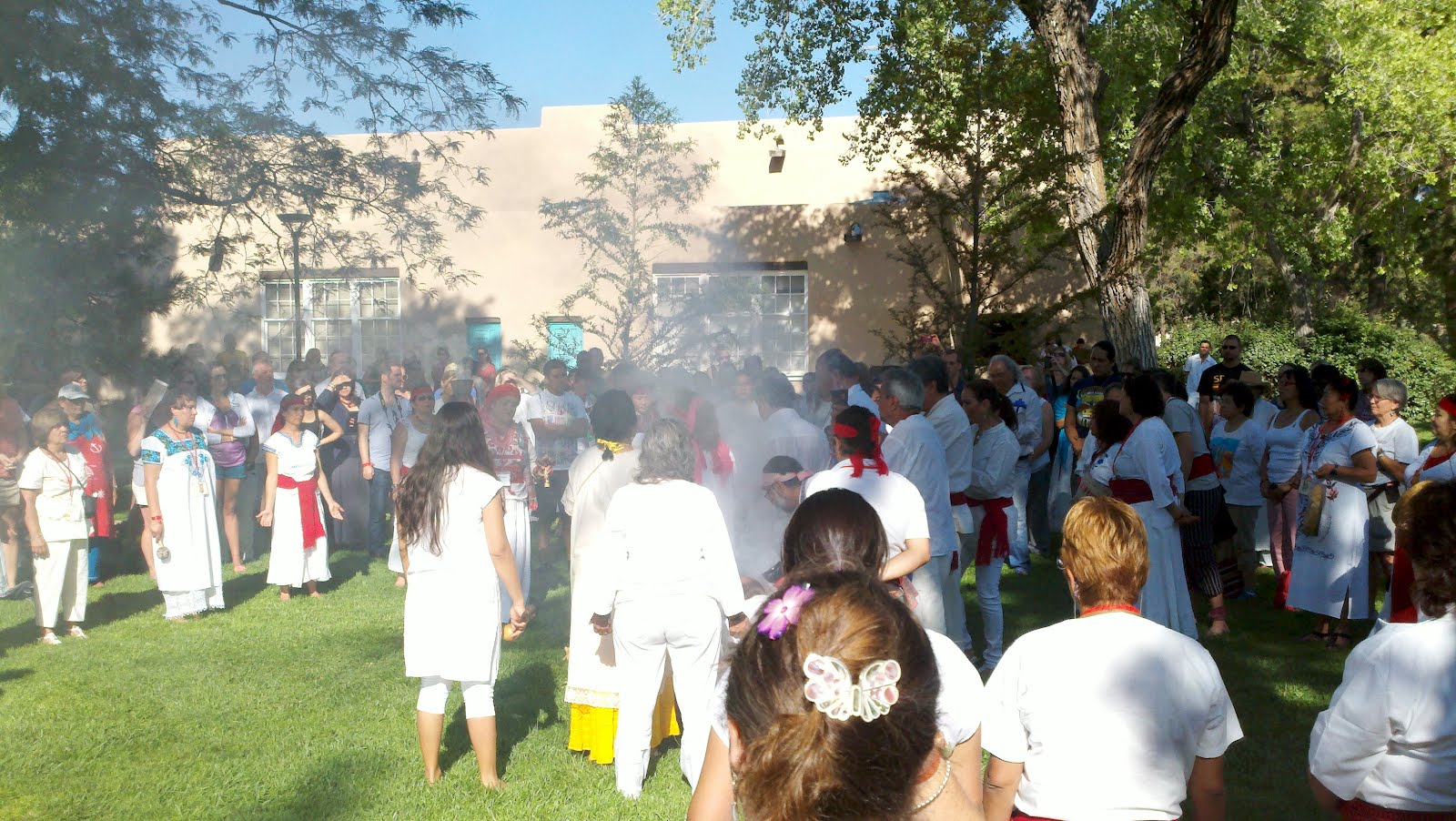
Ceremony with copal smudging at UNM.  Photo by Brett Hendrickson.
Eliseo “Cheo” Torres is the Vice President for Student Affairs at UNM but has a strong side interest in curanderismo, about which he has written a couple of books. He’s the organizer and one of the instructors in the course, and one of the most interesting things he does is to invite around forty curanderos and curanderas from Cuernavaca. These curanderos are professors at a diploma-granting school there that specializes in holistic healing. In addition to their knowledge of “traditional Mexican medicine,” most of the speakers from Mexico also specialized in acupuncture, iridology, reflexology, herbology, a plethora of massage techniques, shamanic drumming, and/or Chinese medicine.

The class is ostensibly about traditional Mexican healing. And, yes, it was. We learned about some traditional maladies such as mal de ojo, empacho, and susto. We learned how to administer a limpia, “cleansing,” with eggs and branches of herbs, and about some of the great folk saints of the borderlands. But, we also learned that curanderismo, even in Mexico today, is incorporating other folk and integrative therapies from around the globe. And we were told many times, explicitly and implicitly, that it is energy that ties all of us and all of these therapies together. As you may know, one of the hallmarks of what Catherine Albanese calls “metaphysical religion” is the sense that we live in a cosmos inundated with energy, energy that we can manipulate for our own weal and woe. This energy is the same the world over. To wit, two different curanderas told me: “Mayan and Chinese medicine are exactly the same.” Maybe they are exactly the same if the person consuming them is using them for exactly the same reasons and in exactly the same way.

As you might imagine, there were a lot of New Age-y people from New Mexico in this class. During a time for discussion, one of them commented regarding the Mexican curanderos: “These people are not considered freaky, New Age, weird in their country.” She continued, “It’s so great and so normalized. In my line of work, people often think I’m so freaky.” In her imagination, at least, Mexico is a place where people who do Reiki as well as limpias are totally normal. This was a new twist on the trope that New Age people seek out the “exotic.” This woman seemed to be romanticizing the exotic so that she could feel more acceptable herself in her own American skin.

So, the questions I’ve been batting around go something like this: What is an “authentic” curandera? Is it ok to mix a whole bunch of local indigenous healing traditions together if it’s indigenous people doing the mixing? What does it mean about the construction of Mexican and Mexican American identity that curanderismo is being more and more framed as an ancient native practice rather than a colonialism-spawned syncretic tradition? Are Mexicans who reclaim Aztec or Maya traditions acting in a way that is inherently Western in its intentions and forms of acquisition and valorization of an imagined utopian past? I’d love to hear your thoughts on these or related questions.

August 3, 2012

Casual Friday

Borderlands History is a blog that started this year. It describes itself as "an academic blog which we hope will promote discussion of issues surrounding the history of the U.S.-Mexico borderlands as well as other borderlands regions." It's not specifically about religion, but you might find it interesting...

Got a photo, link, or other item that you think would be great for Casual Friday? Send it to us!

June 1, 2012

Mexican American and Borderlands Studies: Short-term Research Fellowships

The following announcement recently came across our desk here at the virtual offices of the RAW blog, and we thought you might be interested.  Especially if you do Mexican American and/or Borderlands Studies.  Especially if some of your sources are at UT-Austin.  The deadline is June 4, which is soon!  Herewith, the announcement:

The Center for Mexican American Studies at the University of Texas at Austin announces its first annual competition for three (3) short-term research fellowships at the Nettie Lee Benson Latin American Collection in the fields of Mexican American and Borderlands Studies.

World renowned for its over 1,000,000 books, periodicals, pamphlets, and microforms; 4,350 linear feet of manuscripts; 19,000 maps; 11,500 broadsides; 400,000 photographs and slides; and 60,000 items in a variety of other media (sound recordings, drawings, video tapes and cassettes, DVDs, posters, memorabilia, and electronic media), and periodical titles are estimated at over 40,000 with 8,000 currently received titles and over 3,000 newspaper titles, the Nettie Lee Benson Latin American Collection is one of the foremost research libraries containing materials related to the Mexican American experience and Borderlands Studies. For a listing of Mexican American and U.S. Latin@ archival and manuscript collections see: http://www.lib.utexas.edu/benson/archives/ma_manuscripts.html.

Further, the Mexican American Library Program (MALP) at The University of Texas at Austin was formally established in 1974 by the University Libraries to support the educational needs of students of Mexican American and U.S. Latino culture and history. It is also designed to support the research activities of the faculty of the Center for Mexican American Studies, which has been serving the state of Texas and the nation as a leader in the intellectual development of Mexican American studies since 1970.

Qualifications
Short-term fellowships are restricted to post-doctoral scholars, Ph.D. candidates or holders of other terminal degrees from outside the Austin area who have a specific need to use the Mexican American and Borderlands collections at the Benson Library. Further, projects must demonstrate innovation and substantial contributions to shaping the fields of Mexican American Studies and/or Borderlands Studies. Fellowships are for 2 weeks with a maximum award amount of $750. Fellowships are for travel and housing. Priority will be given to applicants who might not otherwise be able to complete their research without CMAS fellowship support and to applications that focus on the Mexican American and/or experiences of the U.S.-Mexico Borderlands. Award recipients will be announced on June 15th. Residencies may begin on July 1, 2012 and must end by September 1, 2012. Awardees must publicly acknowledge CMAS and the Benson Latin American Collection in any published materials resulting from the fellowship, including doctoral dissertations, articles, and book manuscripts.

Application Guidelines
CMAS-Benson Latin American Collection Short-Term Research Fellowship in Mexican American and Borderlands Studies applications must be received by June 4, 2012. This includes the applicant’s own materials and all reference letters.

Please note: the review committee will not accept applications that include any material in excess of the five main parts described below.

The application consists of five elements:

1. The cover sheet of basic personal and professional information. (see PDF link below)

2. A Project Abstract of no more than 300 words. The abstract must communicate the significance of the project to reviewers in the humanities or social sciences who may not be specialists in the field of inquiry. This should be the overall description of the project.

3. A Project Description of no more than 1,500 words that details the following:
a. Description of the project and its significance to Mexican American Studies. When appropriate, please make specific reference to previously published scholarship that will be revised, improved or supplanted by the proposed project (1000 words).

b. Description of the Benson Collection materials to be consulted (please be as specific as possible) and an outline of the work plan for the fellowship period (500 words).
4. A current Curriculum Vitae (CV) of no more than 10 pages. Please do not submit difficult to read documents. Please be sure to list forthcoming publications and describe their status (in progress, submitted, accepted, in press).

5. Two Letters of Reference. Letters should speak to the promise and innovation of the proposed project, its relevance to work in the Benson Collection with Mexican American and/or U.S.-Mexico Borderlands materials in addition to the talents and qualifications of the applicant. Please send your referees a copy of your project description and remind them of the application deadline. Letters that speak to the CMAS-Benson Collection Short-Term Fellowship are weighted more heavily than those coming from a dossier service. We prefer that letters be submitted electronically and must come directly from the letter writer.

Instructions for Submitting Applications
Applicants must compile their applications electronically and submit them as e-mail attachments by June 4, 2012 at 11:59 p.m. CST.

1. Download the cover sheet from the CMAS website. Fill in the shaded form fields using a word processing application.

2. Attach the following documents to an email using the corresponding file names:
• Cover sheet
• Project Abstract
• Project Description
• CV
Please submit these as four separate documents. The project abstract, project description, and CV may be submitted as Word attachments. PDFs are preferred but not required.

3. Send the e-mail to johannah@mail.utexas.edu with the subject line“(Applicant’s last name) Fellowship Application.”

4. Contact referees regarding letters of reference. We prefer that referees send their letters electronically as attachments to johannah@mail.utexas.edu with the subject line “(Applicant’s last name) Letter of Reference.” In cases where referees are not able to send electronic copies, paper copies will be accepted. Due to the volume of applications, we cannot notify applicants about missing letters. Applicants are responsible for making sure that their referees submit their letters on time and should contact johannah@mail.utexas.edu to confirm receipt.

5. We will acknowledge receipt of applications via e-mail. If we do not respond in three (3) business days of sending the application, please contact us at johannah@mail.utexas.edu or (512) 471-4557. Applications must be time-date stamped by deadline listed.

April 2, 2012

Book of the Month:

Bryan Stone, The Chosen Folks: Jews on the Frontiers of Texas 

Review by Sarah Imhoff


In The Chosen Folks: Jews on the Frontiers of Texas (Austin: University of Texas Press, 2010), Bryan Edward Stone uses the idea of the frontier to conceptualize his history of Texas Jews. Perhaps this should come as no surprise as the tale of a place where the sixteenth century saw Spanish-heritage Crypto-Jews, the eighteenth and early nineteenth centuries presented fighting between white settlers (some of whom were Jewish) and Native Americans, and the subsequent racial landscape claimed Anglos, Blacks, and Mexicans. For some of us, however, thinking about the American West in terms of “frontier” conjures specters of the problematic interpretations of Frederick Jackson Turner: white men courageously conquering the land and its residents, civilization defeating barbarism.

But Stone reimagines the idea of the frontier to be a place of cultural coexistence, interaction, and negotiation. In this way, he writes, “American Jews are, and always have been, frontierspeople” (15). In justifying his choice of central motif, Stone relies on the recent work of Sander Gilman, who has proposed the idea of the frontier as a better image for understanding contemporary Jewish identity (specifically post-1948). Rather than clinging to traditional ideas like Diaspora or exile, using frontier metaphors allows us to imagine Jewish identity in more complex ways than one that identifies Israel as the center and the Diaspora as the periphery. Gilman writes: “Let us imagine a new Jewish history written as the history of Jews at the frontier, a history with no center, a history marked by dynamics of change, confrontation, and accommodation, a history that focuses on the present and in which all participants are given voice. The frontier is not the periphery… it is the conceptual and physical space where groups in motion meet, confront, alter, destroy, and build.” (Gilman, Jewish Frontiers, 15). The idea of the frontier leaves behind the center-periphery in respect to Israel and the Diaspora, but in the American context, it also unseats versions of American Jewish history in which New York serves as the paradigmatic locale of the Jewish experience.

Stone, therefore, sees this model of the frontier as a fruitful one for understanding the experiences and identities of Texas Jews throughout their history. By building on this conceptual framework, Stone’s work aligns with the methodological commitments of what we often call “borderlands” histories. (Although he never explains his preference for “frontier” over “borderlands,” it is clear that for Stone the two share much of their substance and method.) The Chosen Folks traces how the space of conceptual divide, contact, and difference played “a pivotal role in shaping Jewish identity and self-definition in Texas” (2).

At the outset, Stone claims that as frontierspeople, these Jewish Texans made poor Jews, and as Jews, they made poor frontierspeople. Stone shows that strictly observant traditional Jews—what he means here by “good Jews”—never constituted a large portion of Jewish Texans. Without large Jewish communities, religious observance like keeping kosher and observing the Sabbath could be quite difficult. Nevertheless, Stone’s research suggests, the Jews who did make their homes in Texas became different kinds of “good Jews”: Jews who negotiated to adapt and defend Jewish identity and what they saw as Jewish values. His chronologically organized history stretches from the Crypto-Jews and their descendants in the sixteenth century to present. Along the way, Stone provides insightful interpretations of major historical issues as well as the minutia of everyday life. He analyzes the early nineteenth century and its settler-“Indian” encounters in the “wild” region, interfaith friendships, reactions to early Zionism, responses to the Ku Klux Klan, Jewish participation in Texas politics, disagreements about religious practice within the Beth Israel synagogue, reactions to World War II and the Holocaust, and interaction with the Civil Rights movement.

While a single work could never cover all the details of Jewish Texas history, Stone’s wide-ranging attention to “frontiers” in the metaphorical sense allows him to present compelling accounts of both important episodes and larger social trends for Jewish Texans. For instance, his careful attention to the dynamics of the racial and religious components of Jewish identity demonstrates how Jews (as not Black, not Mexican, and not Indian) found themselves firmly in the category of Anglo, and yet nevertheless would experience the acrid rhetoric of the Klan. In this sense, The Chosen Folks sets itself apart from most other histories such as Hollace Ava Weiner’s Lone Stars of David and Jewish Stars in Texas that concentrate on telling the tales of individual personalities and communities.

If we take seriously the idea of the frontier as a metaphor for all Jewish identity—as Stone suggests—then The Chosen Folks may serve as a model for helping us to rethink the metaphorical topography of American Jewish history in two ways. It can help decenter an often New York-centric story, and it can offer a narrative based on borders and encounters rather than center and periphery.

Editor’s note: Have you read this book?  What do you think about it?  Join the conversation and leave your thoughts in the comments!  If you have a suggestion for a future book of the month, or if you would like to review a book for the book of the month series, please contact us. Next month, James Bennett reviews Edward J. Blum and Paul Harvey, The Color of Christ: The Son of God and the Saga of Race in America (University of North Carolina Press, 2012).