Showing posts with label globalism. Show all posts

August 26, 2013

Call for Papers: WHA

Editors' Note: In a continued effort to increase discussions of religion at WHA conferences, we highly recommend that the readers of this blog submit paper proposals to the WHA conferences. We both have participated in past conferences. It is a welcoming, small and friendly place to present your work. Consider using the comments section of this post to pull together possible collaborations with fellow readers!

2014 Call For Papers

54th Annual Conference of the Western History Association

15–18 October 2014, Newport Beach, California

THE WEST AND THE WORLD


The 2014 Program Committee invites proposals that consider the relationship between the West and the world. What forces have connected the North American West with other peoples? Consider, for example, the international links forged by catastrophic events: the fur and hide trade of the 18th and 19th centuries; the mining extravaganzas ranging from the California gold rush to the Klondike; the detonation of atomic, then hydrogen bombs; the end of the Cold War, which allowed indigenous Alaskans and Siberians to reestablish contact; the tsunami of 2011; and the climate change now known as global warming. All of these events have reinforced ties between peoples of the West and their counterparts around the globe.

The Program Committee also invites proposals drawing on vibrant comparative indigenous and borderlands scholarship that explores similarities and differences between the North American West and similar regions (other “Wests”) across the planet. As we gather in Newport Beach, California, on the eastern shore of the Pacific Rim, we are reminded that the West isn’t always geographically west, yet we also find ourselves asking, “What makes it a particular place? What sets it apart as a unique region?”

Perhaps the answer to those questions lies in how the world’s peoples have perceived the West. Have the once romanticized impressions spun by Alfred Jacob Miller and, decades later, members of the Taos Society of Artists been overtaken by 21st-century features such as Starbucks, the City of Las Vegas, and Alaska’s Sarah Palin? In the early years of the second millennium, visitors to the West from Japan, China, and Europe might offer intriguing contemporary responses to resolve that conundrum. Have the earlier perceptions of the North American West changed or do they continue to prevail among outsiders who are intrigued by this unique region of the earth? We look forward to hearing proposals that respond to some of these puzzles regarding the West and the world.

The Program Committee strongly encourages full panel submissions and will consider single papers only when they can reasonably be matched with other panels or papers. When submitting an entire session or panel, include a brief abstract (250 words) that outlines the purpose of the session. Your designated contact person should submit the proposal. Each paper proposal, whether individual or part of a session, should include a one-paragraph abstract and a one-page c.v., with address, phone, and e-mail for each participant. Indicate equipment needs, if any. The committee assumes that all listed individuals have agreed to participate. Electronic submissions are required and should be sent, with supporting materials, as a single document (PDF) to wha2014call4papers@gmail.com. THE SUBMISSION DEADLINE IS September 1.

August 13, 2012

Curanderismo, Reiki, Acupuncture, and Other Traditional Mexican Medicine

by Brett Hendrickson

I recently attended a summer course at the University of New Mexico entitled “Traditional Healing without Borders: Curanderismo in the Southwest and Mexico.” I’ve been a student of Mexican and Mexican American folk and religious healing for a couple of years now and had wanted to attend this class for a long time. Now that I’ve been (and loved it!), I thought I would share what I’ve been reflecting on since returning to the hot and sticky east coast.

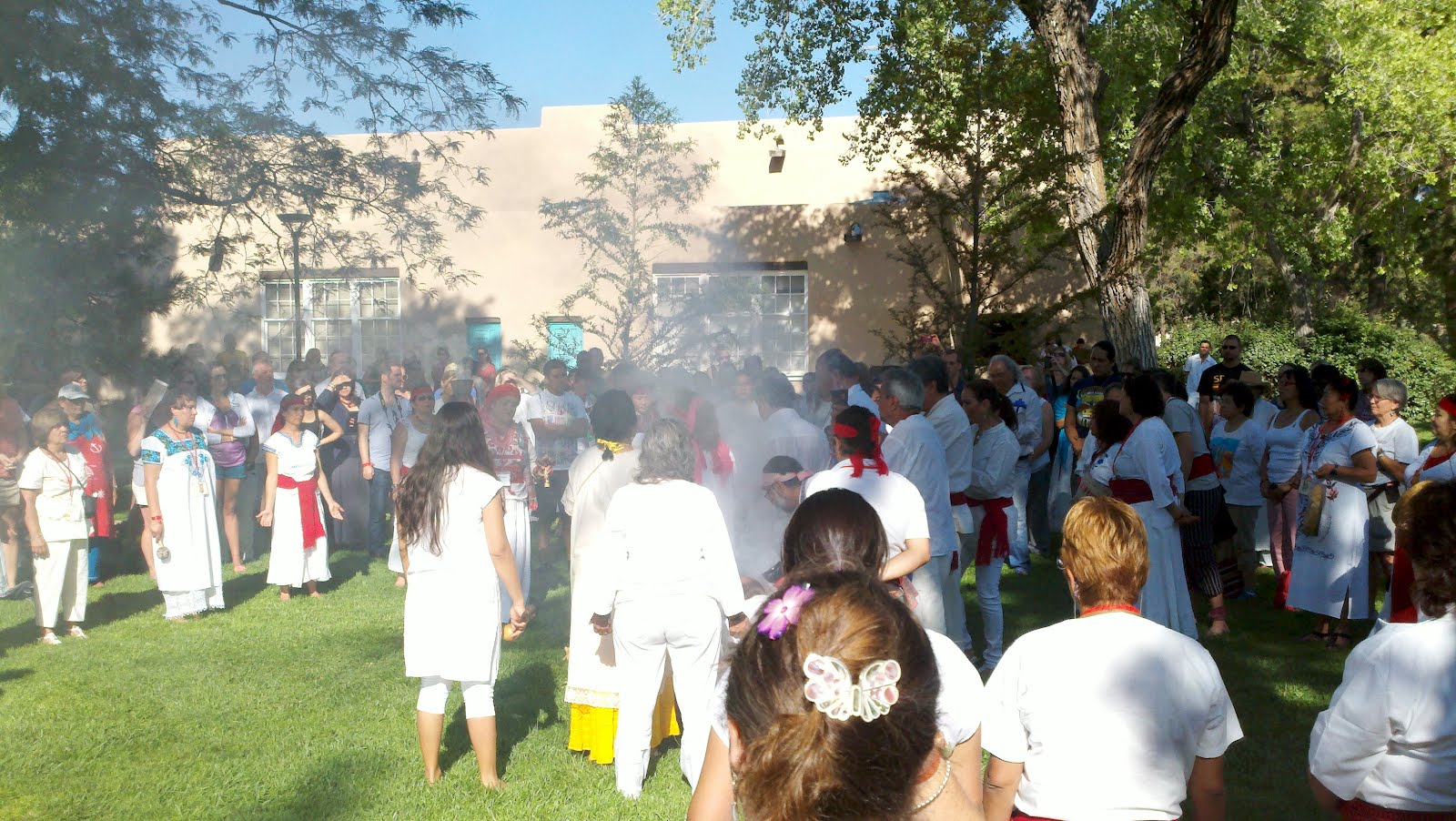
Ceremony with copal smudging at UNM.  Photo by Brett Hendrickson.
Eliseo “Cheo” Torres is the Vice President for Student Affairs at UNM but has a strong side interest in curanderismo, about which he has written a couple of books. He’s the organizer and one of the instructors in the course, and one of the most interesting things he does is to invite around forty curanderos and curanderas from Cuernavaca. These curanderos are professors at a diploma-granting school there that specializes in holistic healing. In addition to their knowledge of “traditional Mexican medicine,” most of the speakers from Mexico also specialized in acupuncture, iridology, reflexology, herbology, a plethora of massage techniques, shamanic drumming, and/or Chinese medicine.

The class is ostensibly about traditional Mexican healing. And, yes, it was. We learned about some traditional maladies such as mal de ojo, empacho, and susto. We learned how to administer a limpia, “cleansing,” with eggs and branches of herbs, and about some of the great folk saints of the borderlands. But, we also learned that curanderismo, even in Mexico today, is incorporating other folk and integrative therapies from around the globe. And we were told many times, explicitly and implicitly, that it is energy that ties all of us and all of these therapies together. As you may know, one of the hallmarks of what Catherine Albanese calls “metaphysical religion” is the sense that we live in a cosmos inundated with energy, energy that we can manipulate for our own weal and woe. This energy is the same the world over. To wit, two different curanderas told me: “Mayan and Chinese medicine are exactly the same.” Maybe they are exactly the same if the person consuming them is using them for exactly the same reasons and in exactly the same way.

As you might imagine, there were a lot of New Age-y people from New Mexico in this class. During a time for discussion, one of them commented regarding the Mexican curanderos: “These people are not considered freaky, New Age, weird in their country.” She continued, “It’s so great and so normalized. In my line of work, people often think I’m so freaky.” In her imagination, at least, Mexico is a place where people who do Reiki as well as limpias are totally normal. This was a new twist on the trope that New Age people seek out the “exotic.” This woman seemed to be romanticizing the exotic so that she could feel more acceptable herself in her own American skin.

So, the questions I’ve been batting around go something like this: What is an “authentic” curandera? Is it ok to mix a whole bunch of local indigenous healing traditions together if it’s indigenous people doing the mixing? What does it mean about the construction of Mexican and Mexican American identity that curanderismo is being more and more framed as an ancient native practice rather than a colonialism-spawned syncretic tradition? Are Mexicans who reclaim Aztec or Maya traditions acting in a way that is inherently Western in its intentions and forms of acquisition and valorization of an imagined utopian past? I’d love to hear your thoughts on these or related questions.

June 18, 2012

Jee Gam and Chinese American Religious Activism

By Joshua Paddison

Portrait of Congregationalist Jee Gam, from N. R. Johnston's Looking Back from the Sunset Land, 1898.
A man named Jee Gam appears on the cover of my book American Heathens: Religion, Race, and Reconstruction in California (published this month by the University of California Press and the Huntington Library). Presumably the image was chosen for its graphic impact and for how it puts a human face on the Chinese and Native American “heathens” who were denied citizenship due to their racial and religious identities during the nineteenth century.

However, I also like the use of this image on the cover for another reason: of all the people who appear in the book, Jee Gam is the person I admire most. Outspoken, brave, and dedicated to public activism, he led an inspiring life.

For readers of this blog, he is of particular interest because of what his life reveals about the religious history of the American West. Jee Gam’s story provides evidence of larger historical patterns characteristic of religion in the West: globalism, frequent migration and border-crossings, tremendous religious conflict and change, violent racial prejudice, and faith-based political activism.

Jee Gam traveled from his native China to San Francisco at age 14, arriving in 1863. He made the journey with his uncle, who had recently returned to China from the gold fields of California. Jee Gam and his uncle were tiny parts of an enormous immigration stream from China to the United States that flowed during the mid-nineteenth century. Forbade from naturalizing due to federal law, these immigrants also faced discriminatory state laws that barred them from voting, holding public office, and even testifying in court against whites. This made them extremely vulnerable to exploitation and violence, exemplified by the murder of 18 Chinese immigrants by a white mob in Los Angeles in 1871.

Still a teenager, Jee Gam found work as a servant in the house of George and Sarah Mooar. George Mooar was a Congregationalist minister and in his household Jee Gam converted to Christianity, soon becoming a colporteur and missionary among Chinese Californians. He joined the First Congregationalist Church in Oakland in 1870 and often worked as a court interpreter. Eventually in 1895 Jee Gam became the first Chinese American ordained as a Congregationalist minister, though he was still unable to become a U.S. citizen.

Illustration of Jee Gam, from the San Francisco Chronicle, September 20, 1895.
From the very beginning, Jee Gam used his influence and access to Protestant resources (newspapers, journals, mission boards, church networks) to fight for Chinese American political rights. In speeches, sermons, private letters, and public writings, he championed Chinese American suffrage and combated Chinese exclusion, passed in 1882 by the federal government. Historians such as Charles McClain and Mae Ngai have shown how Chinese immigrants in the U.S. challenged discriminatory laws via the court system, but the religious activism of Jee Gam and other Chinese Protestants has received virtually no attention.

Jee Gam based his arguments for political rights on a vision of Christianity that emphasized egalitarianism and universal brotherhood. In an era when many Americans believed that the Chinese were too heathenish to genuinely convert to Christianity, Jee Gam insisted on the religion’s inclusivity. “I am a Chinaman and a Christian,” he wrote in 1892. “I am not any less Chinese for being a follower of Christ…. I am in some sense also an American, for I have lived in America almost twice as long as in China.” He went on to call Chinese exclusion “un-American, barbarous and inhuman. It is unchristian, for it is contrary to the teaching of Christ.”

His work on behalf of Chinese immigrants extended beyond California. In 1879, on the eve of exclusion, he embarked on a tour that took him to Chicago, New York City, and Lowell, Massachusetts. He told Chicago newspapers about the daily threat of violence that Chinese Californians lived under from white “hoodlums” and called for suffrage and citizenship for the Chinese. Invited by Henry Ward Beecher to speak at Plymouth Church in New York, Jee Gam insisted that there were “about 1,000 Christian Chinamen in California.” He offered their lives—and his own—as evidence of the efficacy of mission work and the need to maintain open national borders.

Unlike many nineteenth-century Protestant defenders of the Chinese, Jee Gam resisted the temptation to demonize Catholics or other racialized groups. “Can every man have this faith, be he white, black, red or yellow?” he preached in 1880. “Yes. The beggar can have it as well as the king. The poor can have it as well as the rich; and the negro, the Indian and the Chinaman.” This sort of interracial, universalist rhetoric was becoming more and more scarce nationwide in the years following the end of Southern Reconstruction.

Jee Gam married a Chinese woman in 1871 and they had ten children, several of whom attended the University of California, Berkeley. In 1910, just past the age of 60, he decided to retire to China but died on the steamer en route. Chinese immigrants finally received the right to become U.S. citizens in 1943.

What would Jee Gam think of being on the cover of my book, I wonder? I suspect his first response would be surprise, given the hostility and prejudice he encountered during his own lifetime. However, considering his comfort operating in the public sphere, I don’t think he would object to the attention.