July 15, 2013

New Resource from Jared Farmer!


We received this note from Jared Farmer the other day about a promising online resource

Dear fellow followers of Mormon (and/or Utah) history,

Please excuse the impersonal nature of this note. I simply want to call your attention to a newly launched website that serves as the permanent home for my two (!) free e-books:

• Mormons in the Media, 1830–2012 (revised edition, now in iBooks format as well as PDF)
• The Image of Mormons: A Sourcebook for Teachers and Students

jaredfarmer.net/e-books/

Cordially, Jared

These look to be promising resources. If anyone would like to review them for our blog, please contact us!

June 28, 2013

James W. Scott Regional Research Fellowship Awards for 2013-2014


Western Washington University’s Center for Pacific Northwest Studies welcomes applications for the James W. Scott Regional Research Fellowships, established to promote awareness and use of archival collections at WWU and to forward scholarly understandings of the Pacific Northwest. The fellowships are awarded in honor of the late Dr. James W. (Jim) Scott, a founder and first Director of the Center for Pacific Northwest Studies, and a noted scholar of the Pacific Northwest region. The Center for Pacific Northwest Studies is a program of Western Libraries' Heritage Resources, located in the Goltz-Murray Archives Building.

For more information, see this announcement at H-net: http://www.h-net.org/announce/show.cgi?ID=204537

or here: http://library.wwu.edu/internships_cpnws#fellowships

June 10, 2013

“Religion in the Rocky Mountains and Great Plains” Conference

The Department of Religious Studies at the University of Denver is delighted to host a one-day conference on “Religion in the Rocky Mountains and Great Plains”, to be held Saturday, June 22 at the University of Denver, with the support of an AAR Regional Development Grant. It begins with welcoming remarks at 8:45, panel I 9:00-10:30, panel II 11:00-12:30, lunch 12:30-1:45, panel 3 2:00-3:30, coffee break 4:00-5:30, and keynote speech at 7:00. 

This conference brings together scholars from nine universities and colleges around the United States to examine religious identity and practice (including secular and spiritual approaches) around the region, past and present. It is intended to help highlight and bring greater interest to issues of religious identity and practice in the states of the Rocky Mountains and Great Plains, and to provide an opportunity for faculty, researchers, and graduate students to connect with and learn from colleagues. The conference is envisioned as a catalyst for more sustained efforts at regional community building, including future conferences and workshops.

Conference structure

The conference consists of four panels of paper presentations, arranged thematically, highlighting recent research on 20th-century Protestantism in South Dakota, the development of the “Mormon Migration” website, the rise of non-denominationalism in Colorado and the United States, Judaism in early 20th-century Utah, indigenous studies and religious subjectivity, Muslim women in Colorado, Denver-area black churches as agents of change, and Colorado’s influence on Islamist thinker Sayyid Qutb, among other topics. Dr. Bonnie Clark, Associate Professor of Anthropology at the University of Denver, will deliver the keynote talk, “Follow the Request of the Stone: Spirituality and Gardening in Internment Camps”, about her work on the World War II Japanese-American internment camp of Amache.

Registration and Attendance

There is no cost to attend the conference and registration, while encouraged, is not required. To register, please email Professor Andrea L Stanton: andrea.stanton@du.edu. Lunch and coffee will be provided to presenters and attendees.

Conference Website and Contact Information


For more information about the conference, please visit our website: www.religionintherockiesconference.wordpress.com or email andrea.stanton@du.edu. For more information about Dr. Clark and her work, please visit: http://religionintherockiesconference.wordpress.com/keynote/.

June 4, 2013

Book of the Month

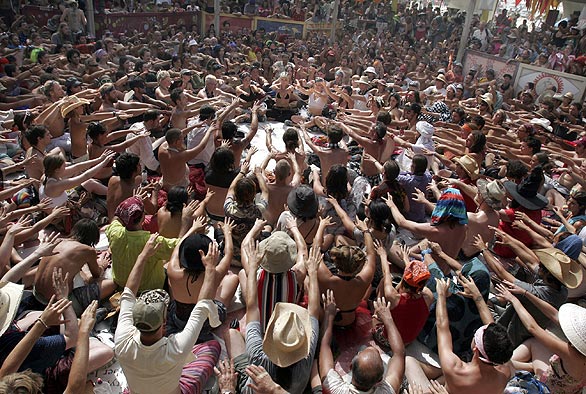
Lee Gilmore, Theater in a Crowded Fire: Ritual and Spirituality at Burning Man (Berkeley: University of California Press, 2010) + DVD. 

Review by Dusty Hoesly


Lee Gilmore’s excellent Theater in a Crowded Fire: Ritual and Spirituality at Burning Man focuses on why so many Burners, as participants call themselves, find the countercultural festival to be culturally and personally significant. Gilmore combines ethnographic fieldwork (based on over a decade of attendance as well as official participation on its Media Team), interviews, surveys, and media reports into a multidisciplinary analysis of religiosity on the playa.

Evolving from a spontaneous effigy-burning on a beach near San Francisco, Burning Man has become a highly organized corporation which manages the annual temporary encampment at Black Rock City in northern Nevada, attracting people from California and around the world. It is a haven and a catalyst for culture jammers and technopagan free spirits. (Incidentally, this year’s theme is “Cargo Cult.”)

Gilmore’s survey data show that most attendees are either “spiritual but not religious” or avowedly secular. By examining this sub-population more closely, Gilmore navigates what religion/spirituality looks like at Burning Man and amongst American “nones” more broadly. For Gilmore, “Burning Man is an important site on the vanguard of this contemporary movement [‘spiritual but not religious’] in which creative expressions of spirituality and alternative conceptualizations of religions are favored, thereby destabilizing and reinventing normative cultural assumptions about what constitutes ‘religion’” (2).

Throughout, Gilmore wisely resists labeling the views of participants or the festival itself as religious, spiritual, or secular. Part of what makes her study engaging and possible is a polysemic understanding of these terms, as well as recognizing the heterogeneity and fluidity of participants’ experiences. Participants’ usage determines how Gilmore operationalizes such terms. Staying close to the ground, in this sense, imbues her analyses with greater legitimacy and persuasiveness. “Ultimately,” she claims, “what matters more to Burners than academic quibbles about what properly constitutes spirituality, religion, or authenticity are their own immediate and idiosyncratic experiences, their encounters with community, their cathartic and visceral rites, and the challenges met and overcome in the crucible of the desert” (155).


Burners seek ritual without dogma, experiences which are spontaneous, immediate, and authentic, open to interpretation, and non-institutional. In this way, Burning Man critiques normative aspects of American culture, even as the meaning of the experiences at Burning Man and the event itself are contested within the community. Transformation occurs not only within individual participants but also in the larger culture, as Burners leave the utopian community on the playa and return to the default society. Burning Man is not just an event but a way of life. 

The theoretical tools Gilmore deploys—from anthropology to religious studies to media studies—are well-suited to elucidate the events taking place at Burning Man. Gilmore argues that Victor Turner’s theories of liminality, communitas, rites of passage, and pilgrimage not only aptly explain ritual experiences at Burning Man, but also that its organizers explicitly model aspects of Burning Man on his concepts. However, Gilmore is careful to point out places where Turner’s theses do not match perfectly with ritual aspects of the festival: for example, noting that even as a homogenizing communitas is created through Burning Man, social and class distinctions amongst participants remain.

Gilmore demonstrates that both the festival and the effigy itself are open signifiers which mean whatever participants want them to mean, even as various in-group members and Burning Man managers articulate a normative vision for what the festival is and should be. While Burning Man is an open ritual that resists routinization as a barrier to spontaneity, immediacy, and authenticity, these elements are also controlled, rehearsed, and familiar, she argues. The communitas at Burning Man is “increasingly normative or ideological,” and thus contrary to the spontaneity which many participants seek and idealize (117-118). This is just one of many examples where Gilmore reads against the grain of the festival, demonstrating shrewd judgment despite her lengthy affiliation with the festival that has “changed the course of [her] life” (167).

How can Gilmore’s book help us study religion in the American West? First, she encourages us to rethink the categories of religion, spirituality, and the secular, privileging emic perspectives over those of scholars, and stressing contestations within groups as well as with outsiders. We might begin to see religious-looking activity in places we had not expected and beyond traditional institutional settings. What counts as sacred space exists in the eyes and bodies of the beholders. Second, this festival may spur us to explore religiosity in the desert beyond asceticism or nature religion, beyond interiorized and solemn experiences of solitude. Third, Gilmore invites us to examine pilgrimage as a tool and category for analysis in Western religiosity. This could include everything from early marketing materials presenting the West as a place for transformative experiences to national parks and environmental tourism to visiting cultural meccas like Hollywood and Portlandia.

As Gilmore’s treatment of Burning Man and the above examples show, there is no clear line separating sacred and secular, and there never has been: “the persistence of alternative spiritualities and the apparent manifestation of spiritual expressions in ostensibly secular venues such as Burning Man is ultimately nothing new,” she contends (63). “The dynamic and creative deployment of religious discourses and ritual symbols in surprising and compelling new ways at Burning Man—and elsewhere in North American society and culture—illustrates how themes such as transformation and redemption that have traditionally been expressed and developed in ‘religious’ contexts are also experienced and ritualized in ‘alternative’ venues such as Burning Man, which many participants understand as a theater for spirituality, self-expression, communal bonding, and cultural transformation” (165).

As an astute analyst who grounds her theoretical interventions in abundant data, Gilmore has written the definitive account of ritual and spirituality at Burning Man, as well as one of the most exciting books yet about religion in the contemporary American West.

May 27, 2013

Studying Religion in the West


by Joshua Paddison

In my previous installment, I discussed some of my experiences teaching an upper-division course on Religion in the Nineteenth-Century American West for Indiana University's Religious Studies department. Today I'll be presenting the students' perspectives. I asked my current and former students to respond to three questions about the course. (I have omitted the names of students who did not wish to be identified.)

1. What was the most interesting or important thing you learned from the class?

Students' most common response related to the religious and ethnic diversity of the West. "While in elementary and high school I had learned about Native Americans in the West, I truly had only a small understanding of the other influences, such as the Chinese and Mexican Americans," commented Sarah Orth. Similarly, Andrew Sweet wrote, "What I had previously learned about American religious history had been, for the most part, focused on the eastern part of the United States and had not dealt too extensively with the American West. This reorientation helped me to understand the vast amount of religious diversity that had been present within the United States even prior to the turn of the 20th century."

Another common response focused on conflict between groups and how power relations shaped religion. "I found it fascinating how religious leaders sought to make sense of frustrating questions: who is Christian? Who is not? Who is 'civilized'? Who is not? The most important thing I learned is that these are not simply religious questions but social, political, racial, economic, and gendered ones," wrote Travis Cooper. Commented another student, "The extent to which different religious/racial groups were persecuted surprised me. I obviously already knew the plight of the Native Americans, but the Mexican, Asian, and especially Catholic persecution was new to me."

On a lighter note, Dason Anderson reported that "the lengthy discussions on Mormonism have given me an annoyingly academic upper-hand when discussing such things in causal social settings."

2. Has studying religion in the American West helped you think about religion differently? If so, how?

Several students reported that they were now more sensitive to the experiences of non-Protestants. "Studying religion in the West made me think about the assumptions we have about religion as Americans, particularly as a 'white' 'American' person and how much these assumptions in the past have had a negative effect on people who were seen as different or were part of a non-normative religion," said Ann Whaley. Joan Ong commented that the course "encouraged me to be more sympathetic and see things from the point of view of minority religions."

Other students said that they came to see the category of religion itself differently. "Although I knew that American religion is more than just Protestantism, I still tended to have a narrow view of religion," said Amanda Koch. "This class reminded me to think more broadly about religion and examine how different religions interact and sometimes blend."  Another student wrote that studying the West "illuminated how changeable and complex religion is. I think this is commonly underestimated because, in American society, we are so used to various ideologies and belief systems, we forget how they've historically been influenced."

Others reported that they came to view religion's role in American westward expansion differently. "I was of the opinion that a good portion of religious sentiment was just thinly veiled justifications for greed and bigotry," wrote Derek Briles. "I now realize that it's much more complex than that."  Another student wrote that the course "contextualized religious identity in the U.S.'s broader cultural, institutional, and political identity. As the U.S. expanded, the question of how it should expand invited existential questions about what the U.S. actually means and represents."

3. What was your favorite reading (secondary or primary source)?

Students especially enjoyed two accounts, one by Red Jacket and another by Wong Chin Foo, that explained why the authors weren't interested in Christianity. "I enjoyed the pieces that offered resistance to the persecution they faced, such as Red Jacket's and Wong Chin Foo's writings," explained a student. "They offered powerful arguments, arguments I would have thought would have swayed the persecutors." Travis Cooper also appreciated those two authors' "compellingly logical retorts to Christianity's 'Manifest Destiny.'"

Another primary source students enjoyed was Chief Seattle's famous speech. In our discussion, we explored the tortured history of the speech -- see Albert Furtwangler's fascinating book for details -- and pondered what, if anything, it can actually tell us about Seattle's religious beliefs. "I enjoyed this reading because it brought forth such an interesting discussion and it reveals the need to truly examine primary sources," commented one student. "It also shows how even with 'historical' documents we need to question them."

Another popular source was Helen Mar Whitney's defense of Mormon polygamy, "Why We Practice Plural Marriage." "It carries implications not only for how we think about religion and marriage historically, but also how we think about it in contemporary societies today," wrote Andrew Monteith.

To my surprise, several students singled out secondary sources as their favorite. Rani-Henrik Andersson's The Lakota Ghost Dance of 1890, Timothy Matovina's Guadalupe and Her Faithful, Amy DeRogatis's Moral Geography, and Cameron Addis's "The Whitman Massacre" all received praise.

I'll give Tyler Dennis the last word on the course: "I learned that historiography has shifted in recent years to focus on a history of the West which does not privilege traditional storytellers, i.e. white/Anglo Americans. Furthermore, that historiography shows that culture did not shift in one direction as whites moved westward. Rather cultural influences moved and reacted in both directions causing synthesis, not conversion."