March 1, 2016

AAR proposals DUE TODAY (March 1st) at 5:00 pm EST!!


Just a friendly reminder to those of you who haven't submitted your paper and session proposals for the Religion in the American West Group's session at this year's annual meeting of the AAR, submissions are due today (March 1) at 5:00 pm EST!

Here is the CFP for the Religion in the American West Group: https://papers.aarweb.org/content/religion-american-west-group

Religion in the American West Group

Statement of Purpose: 
The Religion in the American West Group is a forum for graduate students, independent scholars, and faculty who situate their work regionally in the North American West, broadly conceived. The study of religion in this region allows scholars to use a broad array of methodologies (historical, anthropological, literary, sociological, and others) to explore the most pressing questions in the field of American religion and in Religious Studies more generally. These include, but are not limited to: the history of empire and colonialism; the connections between religion and violence; the construction and deployment of racial, ethnic, gender, and sexual identities; transnational movement of people and ideas; religion and the natural and built environments; myth-making and its role in the construction and critique of nationalist ideologies; and the development of the category of religion. The purpose of this subfield is not to remain in the American West, to define the West, or to argue that religion in the West is unique. Instead, by situating scholarship regionally, scholars of the American West are able to develop theories and methods that can be useful interpretive lenses for other regions defined by land, transnationalism, migrations, diversity, and colonialism. Moreover, the Group supports the development of a rigorous intellectual community by pre-circulating papers in advance of the national meeting and maintaining a blog.

Call for Papers: 
Migration in the American West: Settling, Populating, Transplanting, Displacing, Moving, Claiming, and Leaving

The American West is an imagined place that is often idealized as new, dynamic, a tabula rasa ripe with possibility. Or, it is the destination of the down and out, the economic migrant and immigrant, the last chance. Or, it is the ancient home of native peoples as well as Spanish haciendas and missions. Finally, perhaps it is also where people depart from, a point of disembarkation to other regions, other lands, carrying with them some ineffable sense of being “Western.” Early histories of the West focused on pioneers and settlement as well on displacement while more contemporary analyses of the West address issues of cultural contact, environmental concerns, transnational flows, and economic growth.
Drawing on this ideational context of mobility, we solicit paper and panel proposals on the myriad intersections of religion with migration into and out of the American West. How have religious homes been made in the West? How have westerners brought their religions with them when they leave the region? How have racial, ethnic, gender, and religious identities been co-constituted in this space of continual migratory cultural flows?
We are interested in all patterns of religion and migration, and also are particularly interested in papers contributing to a co-sponsored session with the Native Traditions in the Americas, on indigenous pilgrimages, forced migrations, and commemorative rides in the Western United States.
Please note that the format for the session will feature pre-circulated papers as is the long custom of this group.

“Reimagining or Reclaiming Home: Pilgrimages, Forced Migrations, and Commemorative Rides”, as related to the western United States. This topic is for a possible co-sponsored session with the Native Traditions in the Americas.

Method: PAPERS
Process: Proposals are anonymous to chairs and steering committee members during review, but visible to chairs prior to final acceptance or rejection 
Leadership: 
Chair
Steering Committee

February 18, 2016

Book Review: Mormonism and American Politics


Mormonism and American Politics. Edited by Randall Balmer and Jana Riess. 264 pp. New York: Columbia University Press, 2015. $30.

Reviewed by Brenna Keegan

Mormonism and American Politics begins with the simple claim, “The story of Mormonism in America is inextricably tied to politics” (ix). Thirteen insightful case studies, written by some of the top Mormon studies scholars, persuasively argue the truth of this statement. Randall Balmer and Jana Riess’ edited volume moves beyond the familiar story of Mormons as political outsiders and gives voice to diverse political discourses.  Structured chronologically, Mormonism and American Politics is bookended by Joseph Smith’s 1844 campaign for president and an analysis of Mitt Romney’s 2012 campaign. The pages within highlight the protean history of Mormon isolation and participation in national politics and American exceptionalism, the politics of polygamy, Mormon race relations, and the Church of Jesus Christ of Latter-day Saints’ stalwart participation in the twentieth-century Republican Party.
The volume offers concise examples of Mormonism’s distinct and extensive participation in American politics. It complicates a narrative of gradual assimilation and the increasingly common project of comparing Mormon history with that of American Catholicism. One of the most compelling chapters, “On the ‘Underground’: What the Mormon ‘Yes on 8’ Campaign Reveals About the Future of Mormons in American Political Life,” by Joanna Brooks, highlights the internal conflicts of supporting anti-LGBT legislation and the distinctive theological stance of Mormon support for California’s Proposition 8.
Although Mormon women may not have historically played a strong public role in American politics, their absence from the volume is apparent. A strong chapter by Jana Riess looks at the nineteenth-century Cult of True Womanhood and Protestant women’s protest against Congressman-elect and polygamist B. H. Roberts, but Claudia L. Bushman’s “Mormon Women Talk Politics,” is an odd amalgamation of songs and personal reflection, with little scholarly analysis.
As one might expect, Mormonism and American Politics spends a substantial amount of time considering the legacy and influence of George and Mitt Romney. “Like Father, Unlike Son: The Governor’s Romney, the Kennedy Paradigm, and the Mormon Question” by Randall Balmer and “Mitt, Mormonism and the Media: An Unfamiliar Faith Takes the Stage in the 2012 U.S. Presidential Election” by Peggy Fletcher Stack, add depth and breadth to the debate.

Of particular interest to this blog is the volume’s treatment of Mormonism not solely, or even primarily, as a religious anomaly of the American West, but an active participant in national politics and history. As Philip Barlow rightly notes, “The religion’s infancy was harbored in the nation’s adolescence; both took form together” (109). Well-researched, with short and concise chapters from a distinguished team of scholars, Mormonism and American Politics does not offer a definitive history, but begins the conversation in stride.

January 6, 2016

CFP for Religion in the American West Group at AAR 2016


The American West is an imagined place that is often idealized as new, dynamic, a tabula rasa ripe with possibility. Or, it is the destination of the down and out, the economic migrant and immigrant, the last chance. Or, it is the ancient home of native peoples as well as Spanish haciendas and missions. Finally, perhaps it is also where people depart from, a point of disembarkation to other regions, other lands, carrying with them some ineffable sense of being “Western.” Early histories of the West focused on pioneers and settlement as well on displacement while more contemporary analyses of the West address issues of cultural contact, environmental concerns, transnational flows, and economic growth.
Drawing on this ideational context of mobility, we solicit paper and panel proposals on the myriad intersections of religion with migration into and out of the American West. How have religious homes been made in the West? How have westerners brought their religions with them when they leave the region? How have racial, ethnic, gender, and religious identities been co-constituted in this space of continual migratory cultural flows?
We are interested in all patterns of religion and migration, and also are particularly interested in papers contributing to a co-sponsored session with the Native Traditions in the Americas, on indigenous pilgrimages, forced migrations, and commemorative rides in the Western United States.
Please note that the format for the session will feature pre-circulated papers as is the long custom of this group.
AAR's online portal for submitting papers for the 2016 annual conference is now open. Click here for the Religion in the American West Group's CFP on the AAR website. The deadline for submissions is March 1.

November 5, 2015

Religion in the American West Group at the AAR


We are excited about our upcoming gathering at the AAR in Atlanta! Our session is on Saturday, November 21, from 4:00 to 6:30pm in Hilton-307.

This year’s session is titled “Religious Promotion and Sacred Space in the American West.” The American West has long been known for innovative forms of religious self-promotion from the miracle-working snake oil salesman to the charismatic founders of new religious movements to the well-coiffed stage preacher. The four papers that make up this session explore how unique western spaces and sites have combined with religious self-promotion and self-definition to create new and often contested forms of religious practice.

As is the custom of the Group, all four papers will be pre-circulated, and presenters will give only short points of entry into their papers. This year, Prof. Sarah Pike of California State University, Chico, will respond to the papers before opening up the floor to lively Q & A. The papers will be available to AAR members by November 1 here. (https://www.aarweb.org/aar-full-paper-submission-program)

Presenters and their paper titles:

Jenna Gray-Hildenbrand, Middle Tennessee State University
“Religion, Fraud, and the American West: The ‘I AM’ Activity and Defining the Limits of Religious Freedom”

Justin Doran, University of Texas
“Bayou Revival: Houston as the Contact Zone between the New South and the American West”

Megan Goodwin, Bates College
“‘This Is Not About Religion’: The State of Texas v. Yearning For Zion”

Angela Tarango, Trinity University

Isaiah Ellis, University of North Carolina
“Hunting Buffalo in Oklahoma: Native American Casinos, Sacred Land, and Portrayals of of Native Culture and Religion”


We hope to see you all at the meeting and hope that you can stay for the business meeting afterward!

October 20, 2015

CFP: Religion in America at AAR-Western Region


Religion in America

Fitting into the larger 2016 Conference theme in the broadest of terms, the Religion in America Unit seeks papers that explore how faith has shaped the concept of Social Justice, both in theory and practice. Our Unit is also curious to better understand how 'ethical disaffiliation' (i.e. the act of leaving one's religion for moral reasons) is changing the landscape of both religion and social justice work. For instance, recent research indicates that over 30% of Millennials left the faith into which they were born because they believed it to be hostile to the LGBT community. Where are these and similar trends taking the US? Are there historical case studies (e.g. abolitionism, prohibitionism, etc.) that shed insight into current realities?

While this relationship between faith and social justice is a general topic of the larger conference, call for papers within the Religion in America Unit remains open to considering papers that go beyond this topic.

Please send title, abstract, and participant form to Konden R. Smith, Ph.D., at krsmith1@asu.edu and Chase Laurelle Way chase.laurelle.way@gmail.com

August 28, 2015

Call for Papers:

Race, Gender, and Power on the Mormon Borderlands
Announcement published by Dee Garceau on Wednesday, August 19, 2015

Date: October 15, 2015

Subject Fields:
African American History / Studies, Canadian History / Studies, Native American History / Studies, U.S. - Mexico Borderlands, Women's & Gender History / Studies

CALL FOR PAPERS:
Race, Gender, and Power in the Mormon Borderlands
Mormon history lies at the borders between subaltern and dominant cultures. On the one hand, due to their unusual family structure and theocratic government, Mormons were a persecuted minority for the better part of the nineteenth century. On the other, Mormons played a significant role as colonizers of the North American West, extending their reach to the borderlands of Mexico, Canada, and the Pacific Islands. There Mormon colonists intermarried with Native Americans, Mexicans, Hawaiians and Samoans, even as they placed exclusions on interracial sexual relations and marriage. During the nineteenth century, Mormons also discouraged Native peoples’ polygamous practices while encouraging plural marriage for white women. And for the better part of the twentieth century, Mormon religious doctrine subordinated persons of color within church hierarchy. African-American men, for example, could not hold the priesthood until 1978. Historically, then, Mormons have navigated multiple borders-- between colonizer and colonized, between white and Other, and between minority and imperial identities. This limnal position calls for further investigation. We propose an anthology of essays about race, gender, and power in the Mormon borderlands.
Over the past thirty years, historians of Mormon women have expanded our understanding of gender and power in Mormon society. However, most of these studies focus on white Mormon women, while Mormon women of color have remained largely invisible. This volume seeks not simply to make visible the lived experiences of Mormon women of color, but more importantly, to explore gender and race in the Mormon borderlands. Taken together, these essays will address how Mormon women and men navigated the complications of minority and colonizer status, interracial marriage and doctrinal race hierarchies, patriarchy and female agency, vigilante violence and religious responsibility, and plural identities. These metaphoric borders were brought into play on the geographic and cultural borders of the United States. Specifically, this volume will encompass the continental U.S. West, the borderlands of Canada and Mexico, and Pacific Rim islands such as Samoa and Hawaii, from the nineteenth through twenty-first centuries. A focus on intersectionality in the borderlands promises to open new directions for Mormon history in concert with recent trends in western history. 

The anthology will be co-edited by Dee Garceau, Rhodes College, garceau@rhodes.edu, Andrea Radke-Moss, Brigham Young University-Rexburg, radkea@byui.edu, and Sujey Vega, Arizona State University, sujeyvega@asu.edu . Please feel free to contact us with any questions you have. 

Please send your article abstract or manuscript as an email attachment by October 15, 2015 to Dee Garceau garceau@rhodes.edu , phone: 901-484-1837.

Contact Email: garceau@rhodes.edu

April 24, 2015

Job Announcement: VAP in American Religions @ University of Wyoming


The Religious Studies department at the University of Wyoming announces a one-year position in American religions at the rank of Visiting Assistant Professor or instructor, beginning in August 2015.  Responsibilities include five undergraduate-level courses over the academic year, with at least one of these taught online.

Required qualifications: Ph.D. in Religious Studies or related discipline, or evidence of imminent completion of the degree; demonstrated expertise in American religions.

Preferred qualifications: Specialization in religion in the American West; ample experience in undergraduate teaching.

To apply: Submit a cover letter and CV, as email attachments to: relstudies@uwyo.edu.  Please include names and contact information for three recommenders in cover letter.

Review of applications begins May 5, 2015, and will continue until the position is filled.

Direct any inquiries regarding this position to Quincy D. Newell, qdnewell@uwyo.edu.

The full job ad can be found here.

The University of Wyoming is an Equal Employment Opportunity/Affirmative Action employer.  All qualified applicants will receive consideration for employment without regard to race, color, religion, sex, national origin, disability or protected veteran status or any other characteristic protected by law and University policy.  Please see www.uwyo.edu/diversity/fairness.

We conduct background investigations for all final candidates being considered for employment. Offers of employment are contingent upon the completion of the background check.

April 20, 2015

OAH Presidential Address: On Social Amnesia and Neutrality as Public Performance


This past weekend Patty Limerick, Faculty Director and Chair of the Board of the Center of the American West at the University of Colorado, delivered the presidential address at the OAH 2015 annual meeting. Her address, "Historians as Public Intellectuals: A Cost-Benefit Analysis, Seen from the Interior" considered how historians can help society avoid amnesia.

To revive the profession and its place in American culture, Limerick encouraged members of the Organization of American Historians to think less about professors and the academy and more about the story, or stories, that bring life to their work. Limerick used herself as an example of a historian who lived the kind transition she is encouraging: moving from an early career scholar focused on speaking to her field (with monographs like Legacy of Conquest) to a historian who speaks to a larger public audience about the importance of historical context (writing briefs for Congress, hosting public events and forums through the Center of the American West, and applying historical methods to endeavors other writing books).  In both kinds of efforts, Limerick sees her role as supplying historical perspective in order to better understand and shape the future. Rather than detract from her role or status as a scholar, Limerick argues that her work engaging the public brings greater credibility to her scholarship and enhances her purpose as a historian.

Limerick's speech is well timed as as the April 2015 issue of Perspectives on History also considers the current state of the profession. Perspectives provide a roundtable on a related concern: "History as a Book Discipline. It's worth reading after watching the entire presidential address, which can be found here courtesy of History News Network. 


April 13, 2015

Meet Me in St. Louis

Daniel Schwen, "St. Louis on the Mississippi River by night," January 27, 2008.
 The 2015 meeting of the Organization of American Historians is coming up this weekend: April 16-19.  (The program can be found here.) The theme is this year is "Taboos" with panels that promise to discuss "what historians miss when we avoid topics that have come to be regarded as taboo."

Readers of Religion in the American West will not be disappointed. Here's a brief round up of panels that may be of interest.

Thursday, April 16, 12:00-1:30PM
Citizenship, Nationhood, and Power in Indian Country

Constitutional Law and History or Constitutional Law in History

Friday, April 17 9:00-10:30AM

The Civil War Era and the American West: Unifying Concepts for Scholars, Students, and Museum Goers

Tradition and Taboo in Asian American History

Writing U.S. History: The View from Mexico

Friday, April 17 10:50AM-12:20PM

New Directions in Asian American History
Indigenous Perceptions of Nineteenth Century Treaty Making

Friday, April 17 1:50PM-3:20PM

State of the Field: 19th Century Indigenous and American Indian History

Challenges of Indigenous Women’s and Gender History


Saturday, April 18, 9:00AM-10:30AM

Looking North and West: New Directions in the Study of Free African Americans

The Limits of Freedom: Labor, Violence, and Coercion in the American West
 
Saturday, April 18, 10:50AM-12:20PM 


Rediscovering the Lost World of Midwestern History

Sex, Religion, and the Outlaw Teachers: Taboo Topics in the History of American Education

Saturday, April 18, 1:50PM-3:20PM

Indigenous Rights and Resistance in Alaska (Twentieth Century)

Memorializing Massacres in the American West
Radical Political HIstories of the Midwest


Saturday, April 18, 5:15PM

Presidential Address: Historians as Public Intellectuals: A Cost-Benefit Analysis, Seen from the Interior
In addition to the panels, St. Louis includes plenty of opportunity for research. According to St. Louis Public Radio, the Missouri History Museum holds the largest collection of Native American artifacts outside the Native American Museum in Washington, D.C. "St. Louis is Rich With Art Collections of the American West" gives other suggestions for research as well, like Washington University's Kemper Art Museum and the St. Louis Art Museum (which has the memorable url slam.org).

March 3, 2015

AAR Deadline Extension


The AAR has performed its annual ritual of extending the deadline for paper proposals (until Wednesday, March 4, at 4:59 pm EST).

It's not too late to submit yours to the Religion in the American West group!

Call for Papers:

Proposals for individual papers or a full session are solicited on the following topics:

• The wielding and negotiation of power and authority in religious contexts in the North American West. Specifically, we seek papers that critically interrogate the various and distinctive forms religious authority has taken in the American West, and the consequences of the exercise of that authority. Possible areas of inquiry include, but are not limited to, discussions of power in relation to land disputes, religious groups and governmental entities, institutional vs. popular religious practices, and the establishment and maintenance of religious authority in the West. Topics for papers should not only be situated in the North American West but should also deal significantly with unique aspects of the region or novel analytical approaches. Papers for this session will be precirculated.

• The post-1965 religious and ethnic demographic changes and realities in the North American West (for a possible co-sponsored session).

• The history and impact of Asian religions and the religions of Asian Americans in the Pacific Rim and the North American West (for possible quad-sponsorship with the Buddhism in the West Group, the Japanese Religions Group, and the North American Hinduism Group).


February 20, 2015

WHA Arrington-Prucha Prize


In recognition of the role played by Leonard Arrington and Father Francis Paul Prucha in Western American religious history, the Charles Redd Center for Western Studies at Brigham Young University funds this $500 cash prize for the best essay of the year on religious history in the West. The cash prize and a plaque are awarded to the author and a certificate is awarded to the publisher. No time period, geographic restrictions, or questions of religious persuasion apply. To be eligible, articles must have appeared in the prior year in a journal, magazine, or edited volume. Any WHA member, as well as the publisher or author of the essay, may nominate an essay. A copy of the journal, an offprint, or a photocopy must be submitted to each member of the award committee.

To be eligible for award in 2015, the article must have appeared in 2014. Deadline to submit to Awards Committee is April 1, 2015. 


February 16, 2015

Digital American West: A Round-Up


Every week Wiki Education Foundation features articles contributed by student editors in its "The Round Up" Series. Earlier this month, they featured contributions made about the American West in The Round-Up: History of The American West. Highlighting contributions made by students in Dr. Marilynn Johnson's American History West of the Mississippi class, the article features content related to gender and race as well as technology, consumer culture, and violence.

Many thanks to Dr. Johnson's students for contributing content about the American West to the public! Here on the blog we will be featuring student content of our own, especially content that considers religion alongside other social formations. If your class is contributing new digital resources about the American West, then we'd like to add that to our own round-up. Please bring your work to our attention at relamwest [at] gamil [dot] com.

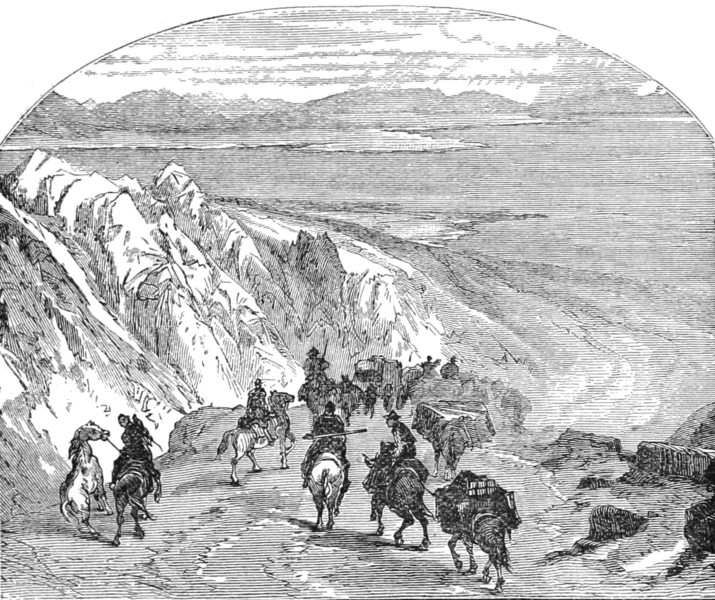
"A pack train," Appleton's Guide to Mexico [1884], found here

February 4, 2015

From the Archives: A 19th-Century San Francisco Chinese Woman's Autobiography


We are pleased to include below the first post in an ongoing occasional series titled "From the Archives." Our first contribution comes from Joshua Paddison.

Autobiography of an Unnamed Chinese Woman
Introduced and Transcribed by Joshua Paddison

The following unnamed Chinese woman’s life story, written “in her own words,” was published in San Francisco’s Presbyterian newspaper, The Occident, on August 5, 1885. At the time, she was an interpreter and resident at the local Presbyterian Mission Home for Girls. Presbyterian missionaries had been working with Chinese immigrants in San Francisco since the 1850s.

In the 1870s, California’s politicians had seized on the figure of the “sinful” and “diseased” Chinese prostitute to urge the necessity of halting immigration from China. This resulted in the Page Act of 1875, the federal government’s first restriction of immigration, which forbade Chinese “coolies” and prostitutes from entering the United States. Protestant missionaries in California generally supported the Page Act but argued that Chinese women could and should be cared for, “uplifted,” and transformed into “useful Christian women.” “What maketh us to differ from them?” asked Presbyterian missionary Samantha Condit in 1874. “God’s grace alone.”

Chinese women’s autobiographical stories such as this one appeared occasionally in California’s Protestant publications, offered as evidence of the progress missionaries were making as well as the redeemability of all of the world’s “races.” These narratives are a largely untapped resource for historians of Asian American history, offering evidence of both the benefits and costs accrued when Chinese Americans joined Protestant churches in the nineteenth century.

January 27, 2015

AAR Call of Papers: Religion in the American West Group


It's that time again...

AAR has posted CFPs and is now accepting submissions for this year's annual conference, which will be held November 21-24, in Atlanta, Georgia.

Below find information for paper submissions to the Religion in the American West Group:

Religion in the American West Group

Call for Papers: Proposals for individual papers or a full session are solicited on the following topics:

• The wielding and negotiation of power and authority in religious contexts in the North American West. Specifically, we seek papers that critically interrogate the various and distinctive forms religious authority has taken in the American West, and the consequences of the exercise of that authority. Possible areas of inquiry include, but are not limited to, discussions of power in relation to land disputes, religious groups and governmental entities, institutional vs. popular religious practices, and the establishment and maintenance of religious authority in the West. Topics for papers should not only be situated in the North American West but should also deal significantly with unique aspects of the region or novel analytical approaches. Papers for this session will be precirculated.

• The post-1965 religious and ethnic demographic changes and realities in the North American West (for a possible co-sponsored session).

• The history and impact of Asian religions and the religions of Asian Americans in the Pacific Rim and the North American West (for possible quad-sponsorship with the Buddhism in the West Group, the Japanese Religions Group, and the North American Hinduism Group).

Link to CFP: https://papers.aarweb.org/content/religion-american-west-group


January 15, 2015

Call for Papers: What should a book on religions in California contain? for CASA 2015 Annual Meeting


Call for Papers: What should a book on religions in California contain? for the 2015 Annual Meeting of the California American Studies Association, held April 24-25 on the campus of California State University, Fullerton.

It goes without saying that religions play a dynamic role in the drama that is the story of California from the beginning through the present. Yet, no one volume yet exists to tell this story in the twenty-first century. Perhaps now, the time is right to for this new project.

What should a book on religion in California contain? What should be its scope, its loci and its foci? What should be its structure? Who should be its author(s)? Three to four presentations are invited to provide a roundtable conversation to explore this topic.

Presentations need not be lengthy (no more than fifteen minutes maximum) nor conclusive (as they are meant to initiate conversation). This detail is important so as not to tax the efforts of any wishing to contribute their proposal to this exploration.

In fact, a quick reply will be sufficient. By January 14 (so that the January 15 deadline can be met), please e-mail a 250 word abstract and a brief (one to two page) c.v. to the panel organizer at ray.kibler.iii@ecunet.org. Questions in advance are welcomed.


January 13, 2015

Western History Association Awards - Accepting Submissions


Award submission information for 2015 is now available online. Click here to view, or visit www.westernhistoryassociation.wildapricot.org and select the "Awards" tab. The deadline for awards submissions is April 1, 2015. Awards will be announced in October at the 55th Annual WHA Conference in Portland, Oregon.


If you have any questions, please email Matt Robinson at whagradstudent1@gmail.com or call the WHA office at (907)474-6509.

January 12, 2015

OAH Workshop: Diversity in the American West


CALL FOR PROPOSALS
January 5 - February 27, 2015

NEW 2015 SUMMER REGIONAL WORKSHOP
Glendale, California
July 17 - July 19, 2015

The Organization of American Historians is pleased to announce a Call for Proposals for its new Summer 2015 Regional Workshop.

The 3-day workshop, titled Diversity in the American West, will be held on the campus of Glendale Community College, located ten miles north of downtown Los Angeles, from Friday, July 17 through Sunday, July 19, 2015.

The Program Committee invites proposals from college faculty (from both two-year and four-year institutions); high school faculty, including AP History instructors; historical researchers and writers; librarians: museum curators; public historians; advanced graduate students; and other educational professionals.

The purpose of this workshop is to offer history educators a meaningful opportunity to learn more about the diverse people, places, and historical themes of the American West. Some questions to consider include the following: What are the major trends in contemporary research and historiography of the American West, particularly as they relate to the theme of diversity? What strategies can be used to engage students and the general public in the history of the American West? How might instructors build and enhance their teaching of American History survey courses to include the history of the American West?


Submissions will be accepted between January 5, 2015 and February 27, 2015.

For further information and submission instructions please click here.


November 5, 2014

The Papers Are Now Available!


The Religion in the American West Group will be kicking off its first AAR (American Academy of Religion) meeting as an official, permanent program unit with a selection of excellent papers by Rebecca Tatum, Sarah Koenig, Brennan Keegan, and Jason Allen Redden.

The theme for our session, which meets Sunday, November 23, from 9:00 to 11:30am, is “Western Borderlands: Families and Congregations.”

The session’s description is:

In the North American West, there are numerous sites of contact at geopolitical borders as well as at boundaries of race, class, ethnicity, gender, and religion. This session’s papers examine these points of contact and negotiation from two broad vantage points. The first has to do with the birth and care of children and religious understandings of bodies; papers consider the role of Native American wet nurses and New Mexican midwives. The second has to do with the spread of evangelical Christianity in unique Western settings; papers explore missions to indigenous groups in British Columbia and to mining towns in Montana. These papers show that domestic, commercial, and Christian spaces have intersected in the North American West in complex and creative ways.

Following our tradition, the papers are pre-circulated and are available now for you to read carefully. Presenters will give only short introductions to their papers so as to leave ample time for comment and discussion. The official respondent this time around is Professor Colleen McDannell of the University of Utah.

To access the papers, follow these steps:

1.      Join the AAR if you have not done so already. Access to the papers is limited to AAR members.
2.      Go to this website: https://www.aarweb.org/aar-full-paper-submission-pilot-program and scroll done to our session.
3.      Click on the paper titles to read the papers.
4.      Come on Sunday, November 23, with your questions and comments!


We look forward to seeing everyone in San Diego!

October 23, 2014

Book of the Month: Review of David Silverman's Red Brethren: The Brothertown and Stockbridge Indians and the Problem of Race in Early America


Review by Matthew W. Dougherty


David J. Silverman Red Brethren: The Brothertown and Stockbridge Indians and the Problem of Race in Early America (Ithaca, NY: Cornell University Press, 2010)


David J. Silverman’s Red Brethren follows two multi-tribal American Indian communities—the Brothertowns and the Stockbridges— whose westward migrations reveal new facets of religion and race in early America. Silverman argues that these communities used Protestant categories and concepts both to make sense of the racial identity assigned to them in early America and to propel themselves from New England to New York to Wisconsin. Like white Americans, they migrated for complex reasons: Federal pressure to sell their land and encroaching white settlement contributed, but so did their desire to form autonomous Christian communities and missionize “heathen” American Indians. Silverman thus contributes to the story of the west by showing that white Americans were not the only ones who migrated because of a belief in their particular divine mission. Although his view of the churches at the hearts of these communities grows fuzzier along the journey west, his tightly-focused narrative retains its power throughout the book.

The shared history of the Brothertowns and Stockbridges began in the 1770s and 1780s when Christian Indians from a number of northeastern tribes settled in two new communities—Brothertown and New Stockbridge—in Oneida territory. The move west was made in the hope that the new towns would be stable bases for cultural survival and missions to their “red brethren” in non-Christian tribes. Silverman argues that the Brothertowns’ and Stockbridges’ belief that they had something basic in common with non-Christian Iroquois indicates that they accepted the racial designation of “Indian,” yet attached their own meanings to it. They believed, for example, that the racial oppression they suffered resulted from of God’s curse for their ancestors’ disobedience of the commandments, and would end when divine justice was satisfied. But their acceptance and modification of the prevailing racial category of “Indian” was not without cost: Stockbridges and Brothertowns who married African-Americans were often excluded from the tribe and claims on tribal land. That internal division grew stronger as the communities moved farther west in the 1820s. Hoping that another move would provide more security from white settlers and another chance at evangelism, the Brothertowns and Stockbridges negotiated a treaty with the Menominee to allow them to settle along the Fox River in Wisconsin. In 1831, however, pressure from the U.S. government and tensions with the Menominee forced them to move yet again, this time to the shore of Lake Winnebago. Fearing that further land cessions would be forced on them unless they made a radical change, the Brothertown voted to abandon tribal status and become U.S. Citizens in 1839. The Stockbridge followed suit in 1843, but “gave back” their citizenship and resumed tribal governance only three years later. Silverman argues that disputes over citizenship in these communities were also disputes about race. Both those opposed to the idea and those in favor of it referred to taking citizenship as “becoming white” and saw it as an abandonment of legal Indian identity, for better or worse. These issues still haunt the Brothertowns, whose petition for federal recognition was denied by the Bureau of Indian Affairs in 2012 on the basis that their acceptance of citizenship in 1839 had put an end to their tribal identity.
   
Silverman is fortunate in that the Brothertowns and Stockbridges created an unusually large paper trail. In addition to missionary and government sources, he can draw on the writings of prominent leaders from both communities and on tribal government documents. For the eighteenth and early nineteenth centuries, the copious writings of Brothertown’s founder, Samson Occum, are his main source. After Occum’s death, the paper trail goes on but its character changes: As he follows the story of the Brothertowns and Stockbridges to Wisconsin, Silverman relies more and more frequently on the records of both the tribal and U.S. governments, and has fewer first-person accounts. His choice to focus throughout on the religious and racial self-awareness of community leaders minimizes the shock of the transition, but the loss of Occum as a voluminous, reflective writer and vivid witness does make the latter part of the narrative less immediate and clear-cut.

Silverman’s narrative relies on the category of “Christian Indians” to designate the various Native groups that define themselves at least partly through Christianity in his story. That category fails him, however, in the final chapters of the book. So long as he focuses on New England, the dominance of independent, “New Light” Congregational churches in Christian Native communities ensures that the category “Christian Indian” designates a related set of approaches to religion and community life. As Silverman and other scholars such as Joanna Brooks, Rachel Wheeler, and Linford Fisher have shown, Native-led Congregational churches in New England were in contact with one another, circulated ideas and people, and had distinctive approaches to preserving Native traditions through Christian practice. After the Brothertowns and Stockbridges moved to Wisconsin, however, Baptist and Methodist churches began appearing in their communities, presumably undermining any sense of a unified Christian Indian identity. Silverman’s portrays the development of these separate churches as another sad sign of factionalism (200-202), but doesn’t address how changes in church fellowship and theology might have affected what it meant to be a Christian Indian. For example, did membership in the strongly hierarchical Methodist church constrain Native autonomy more than membership churches governed at the level of the congregation? Did the racial theory of the “curse of God” survive in congregations that moved away from the Reformed theology and Providential view of history underwriting it?  

The fact that we can now ask these questions these about independent Native churches in the west, however, is entirely thanks to Silverman’s groundbreaking work. With careful scholarship and a strong ear for narrative, he has brought to life a story that not only casts light on two remarkable groups whose history challenges many widely-held ideas about American Indian identity, but also persistently and clearly exposes the fault-lines in racial thinking in early America. The re-casting of our stories from the west has brought home the importance of empire, land, and migration as themes in American religious history. Silverman’s book provides a new way of thinking about these themes with a clear, affecting narrative suitable for advanced undergraduates as well as graduate students.