

We had a premature launch of our Twitter account last Friday, but we're happy to announce that we are officially on Twitter. Follow us @relwest1, or ReligionAmericanWest, or here: https://twitter.com/RelWest1.
Thanks for your patience!
October 3, 2012


October 1, 2012
Book of the Month
Reid Neilson. Exhibiting Mormonism: The Latter-day Saints and the 1893 Chicago World’s Fair. New York: Oxford University Press, 2011.
Review by Konden R. Smith

Back in January, Laurie Maffly-Kipp brought up the question regarding Mormonism’s status as a “western” religious tradition. Rather than answering this question, she turned the question around by asking why such labels have been so important and used in the first place. In short, what was at stake in its usage? I think an important answer to this question comes from the Mormon presence at the Chicago World’s Fair (aka. Columbian Exposition) of 1893, covered in Reid Neilson's Exhibiting Mormonism: The Latter-day Saints and the 1893 World’s Fair (New York: Oxford University Press, 2011). At this fair, Utah’s non-Mormon Governor Caleb West re-introduced Mormons as loyal patriots and archetypal developers of the American West. “These pioneers of Utah blazed the way for the westward course of empire, and at the time of their first entrance into the valley of the Great Salt Lake planted the flag of the union on foreign soil.” In part due to West’s successful repositioning of Mormonism under this “western” banner, Americans began, for the first time in American history, to re-imagine Mormons as acceptably American. Recognizing this new and unprecedented national interest in Mormonism, Mormon leaders introduced themselves as “pioneers” rather than “prophets,” and their talking points were buffalos, women’s suffrage and pioneering rather than the Book of Mormon, Joseph Smith or religious persecution. Defining Mormonism as a “western” religion was thus a pivotal moment in Mormon history and the history of American religious pluralism.
The argument behind Exhibiting Mormonism was straightforward: to demonstrate how Mormonism went from a narrow “missionary-minded people to a twentieth-century evangelistic and public relations juggernaut” (7). Although Neilson’s focus was largely on Mormonism’s public relations conversion and subsequent change in policy and attitude toward the outside world, Neilson recognized a broader significance of the international event and the correlated Mormon response. It was, he explains, “a larger story of the church’s accommodation and assimilation into the larger American religious mainstream,” and as such opens itself up for comparative studies of American minority relations and transformation (207). Importantly, the hinge in this pivot was in Mormonism being redefined as “western,” and thereby “American.”
By way of organization, Neilson charts Mormonism’s response to American culture in three parts. (1) 1830-46: The founding period where Mormons sought to convert, not befriend the nation and world. (2) 1847-1890: The pioneer period that was marked as largely non-violent, with the exceptions of the Utah War, 1857-58, and the three decade long “cold war” surrounding the question of Mormon politics, economy and sexuality. Public relations during this period were not important and Mormon provocations were common. (3) 1890-today: Exceptionally strong focus on public relations and education (16-17). As Neilson demonstrates, this last phase did not really take off with the surrender of polygamy in 1890, but more importantly the World’s Fair three years later.
Neilson clarifies that Mormons did not simply “attend” the fair. Their presence was rather complicated, being celebrated and cheered in one section and then rejected and insulted in another. In the chapter that outlines this acceptance, Neilson provides an overview of the size and complexities of the fair itself. In an exhibition of “Utah Territory,” Mormons displayed their “western” identity to the nation. Over two million visitors toured the Utah building, having a dramatic impact on how non-Mormons saw Mormons and how Mormons sought to present themselves. As part of this new “western” presentation, Utah was represented by way of mineral deposits and mummies, rather than Mormons and polygamy.
Perhaps most profound to the question of Mormonism’s entrance into Americana is Nielson’s chapter on Mormon women at the fair, as it was them who led this early “Mormon moment.” Whatever success Mormon leaders found at the fair, Mormon women had already “woven themselves into the larger fabric of domestic and international feminism,” and, as such, found themselves well received (102). With much less foresight, male leaders initially resisted representation at the fair and remained outside and detached from ecumenical associations, such as the Evangelical Alliance. With a desire to be part of the national female suffrage movement, Mormon women early on recognized the value of national inclusion. Ironically, popular portrayals of Mormon women were that of being slow, stupid, and mere erotic tools of Mormon male masters. Participation at the World’s Congress of Representative Women was thus not only a watershed moment for the American feminist movement, but as Neilson demonstrates, allowed Mormon feminism to merge with that of the national. The Mormon female Relief Society and the Young Ladies Mutual Improvement Association (YLMIA) stood side-by-side at the fair with the National Council of Women of the United States (NCW) (104).
Beyond the Mormon female presence at the fair, the Mormon Tabernacle Choir at the Welsh Eisteddfod, an international musical competition associated with the fair, proved the magical element for healing Mormon-American relations. Welsh Americans looked to such an event as a way to demonstrate their retention of Welsh culture and musical influence within America. For Welsh Mormon immigrants, such as Mormon Tabernacle Choir conductor Evan Stephens, the choral competition represented a similar opportunity to display Welsh civilization and Americanism as filtered through the Mormon machine. Though being redefined as “western,” Mormon sophistication emerged, in part, outside the US. In an attempt to be more warmly welcomed as “Americans,” Mormons from various nationalities heartily embraced this new “western” national identity, however Danish, Welsh, or English they were. The result of this appropriation was a resounding success, as Neilson put it, “thanks in large measure to the Tabernacle Choir, the Chicago World’s Fair seemed to mark a new dawn for the public image of the church, at least as a cultural institution,…” (144).
But as Neilson explains in a later chapter, not all was well for Mormonism at the fair. Though it was true that Mormon leaders at first saw little importance with the fair, Mormon orator and leader Brigham H. Roberts was the exception. In what amounted to a story of excellent drama, Roberts convinced leaders of the Parliament of Religions to bring him on as a speaker. Parliament organizers finally agreed, but following a speech on Islam that defended the practice of polygamy, the polygamous Roberts found his speech sidelined and he left the parliament resentful and bitter. But Roberts had friends, most importantly a Roman Catholic parliament official who defended Mormonism and decried its exclusion as ignorance and prejudice.
Being largely descriptive rather than analytic, Exhibiting Religion proves an important contribution to the study of the American West. Beyond this, it is an important contribution to Mormon Studies and its larger patterns of religious accommodation, boundary maintenance and identity formation more generally. My only real criticism of Neilson’s work is that it lacks analysis in any broad way. The focus is on Mormonism and its entrance into the American heart and its consequent conversion to PR. But Neilson’s stated goal was not to bring in this national and even international religious, political, economic, and cultural context. Instead Neilson leaves intact the larger implications of this dynamic encounter of Mormonism at the fair for future scholars to dissect and elaborate on. Indeed, this is Neilson’s true contribution.
To return to the original question regarding what was at stake in being “western,” Mormonism found that a more positive relationship to the nation depended upon this new distinction. Whatever was meant by the term, it seems clear that it signified “American.” As such, instead of speaking on Mormon themes, such as the Book of Mormon, temples, and religious freedom, Mormon men and women spoke instead of settlement building and on pioneering rather than prophets and saints. In this case, “western” represented an identity that Mormons, though perhaps not Mormonism, could fit into. As Neilson put it, “the church was eventually integrated into Americana in spite of, not because of, its religious contributions” (178).
As Neilson reminds us, Mormonism’s effective PR campaign did not begin with the “Mormon moment” in 2011-2012, but rather the World’s Fair of 1893. Recognizing this early history we learn a bit about what was at stake in being defined “western” as well as the enthusiasm Americans held in its celebration. Mormonism’s success in PR has little to do with the nation beginning to appreciate religious difference, but rather because Mormons allowed them to forget their religious difference by blinding them with being “western.” In asking why presidential contender Mitt Romney rarely speaks of his faith in public, we can recognize that it likely has something to do with his recognition that America may not be ready for a “Mormon” in the Whitehouse, however much they have come to accept the idea of a president who happens to be Mormon.
September 28, 2012
Casual Friday: Social Media
We're happy to announce a new Twitter page! You can find us at RelWest. We'll tweet new blog posts when they are posted on Fridays and Mondays.
If Facebook is more your speed, we've been there for a year. You can find us under "Religion in the American West." The Facebook page has been on hiatus, but you will start seeing notifications for new posts there as well.
Update:
The Twitter account has not gone live yet--stayed tuned for further updates!
If Facebook is more your speed, we've been there for a year. You can find us under "Religion in the American West." The Facebook page has been on hiatus, but you will start seeing notifications for new posts there as well.
Update:
The Twitter account has not gone live yet--stayed tuned for further updates!
September 24, 2012
James Sheerin’s Search for the Holy Grail: Perceptions of Religion in the American West
By Dusty Hoesly
While writing a review of Chas. H. Barfoot’s Aimee Semple McPherson and the Making of Modern Pentecostalism, 1890-1926 (2011), I became intrigued by an obscure source on religion in the American West that he cited. In 1923 and 1924, the Episcopalian periodical Southern Churchman published six articles in a series titled “A Little Journey in the West,” written by Reverend James Sheerin (1865-1933), a Scotland-born immigrant who studied theology and served many roles within the Episcopalian church.* Throughout the essays, Sheerin reported on “religious conditions” west of the Mississippi River as he traveled by train, with a particular eye toward the shape and success of Episcopalian churches. For his part, Barfoot focused on Sheerin’s account of McPherson’s preaching and her work at Angelus Temple in Los Angeles. In this post, I will summarize Sheerin’s observations and offer some thoughts about what his writings might say about perceptions of religion in the American West.
Inspired by Richard Harding Davis’ The West from a Car Window (1892), Sheerin sought to explore what religion looked like across the American West. In the beginning of his series, Sheerin clarified that by “the West” he meant west of the Mississippi River, a working definition echoed by many scholars. Starting from Denver, he traveled to Salt Lake City, Sacramento, the San Francisco Bay Area, and Los Angeles (and Southern California generally), before returning through the Southwest and back into the Midwest. Unfortunately, the Pacific Northwest is omitted entirely, and the Southwest and Midwest are relegated to only a few snippets in the fifth essay. Most of his observations center on California, which he perceived as the climax of his Western travels. Ultimately, he lamented the “notable lack of external Church signs as one goes West” and, in the end of the series, offered solutions to increase the Church’s influence there. In searching for the Holy Grail of Christian life, he mostly found empty cups and near-empty chapels.
Consistently, Sheerin chided churches in the West, and the Episcopal Church in particular, for low attendance, lack of ornamentation like steeples or towers, and for their general sparseness (especially in agricultural areas). He also lamented that the Episcopal churches he visited catered only to wealthier, educated, urban, East coast immigrants, to the neglect of poor and rural residents. Schools were built before churches, he claimed. These criticisms, like most of his observations, rest on an institutional view of religion, one that focuses on the ratio of church congregants to city populations; the number of churches, hospitals, schools, and seminaries; and the presence of steeples and grand architecture gracing the skyline. The daily spiritual practices of people in the American West escape his attention.
In the first article, Sheerin became enamored of Denver, which he called an exception to the lack of outward displays of religiosity he perceived in the West. It was “more religious, artistic and educational in its ideals than most other Western cities,” he wrote. In particular, he delighted in the prominent position of the Episcopal Church there, which he credited to the towering efforts of Bishop H. Martyn Hart. Similarly, he praised the successful ecumenical relationship between Episcopalians and Mormons in Salt Lake City, and he especially regarded the “socialistic” liberal bishops there, chiefly Bishop Frank Spalding, who Sheerin felt “won for the Episcopalian Church the interest of a multitude who are usually indifferent or hostile to organized religion.” In discussing religiosity in the West, Sheerin paid close attention to the unchurched and sought ways to mission to them.
Moving westward through the Sierra Nevada mountains, Sheerin used the sparseness of churches there as the basis of a critique of the Episcopal Church generally. Of Nevada, he wrote, “The whole region is suggestive of merely temporary effort, ecclesiastically or otherwise.” And of Sacramento: “Like it or not, so far as the United States of America are concerned, the Episcopalian Church seems to be chiefly a City Church, and if Christianity in rural districts depended on it, the country would be in a very bad way, indeed.” Even in San Francisco, despite the lasting effects of the 1906 earthquake and subsequent fires on church buildings, Sheerin claimed, “Certainly the voice of religion, so far as its outer fabric goes, is less in evidence than that of commerce or amusement.” The familiar narrative of struggling Protestantism—at least in its institutional forms—in the American West is evident throughout his articles. Too bad he never included interviews with people who might have described their religious beliefs and practices; instead, we are left with only his partial impressions based upon low numbers of congregants and church buildings.
However, despite the dearth of church steeples dotting the landscape, Sheerin grew more excited as he traveled west, charmed by the natural beauty and theological open-mindedness he found as he approached the Pacific. He argued, “In Denver, outside an aggressive element of excessive Churchmanship, and a tendency to run after healing and other evanescent cults, there seemed to be more of a love of social service than of religious dogma. This better atmosphere seemed to increase as one approached the Pacific Ocean. It may be too fanciful to attribute broadening theologic [sic] influences to oceans, but it does seem to be a fact that the great cities on either coast have a freer intellectual atmosphere than is usual in interior places!” In awe, he asked rhetorically, “Can people live between high mountains and the greatest of waters and remain permanently small in mind?” Many scholars today remark about how scenic grandeur inspires spirituality in the West, and it seems Sheerin was captivated by that same impulse. Out West, according to Sheerin, nature inspires broadened theological horizons.
He continued: “All of this is preliminary to the claim that when one has crossed the great plains and mountains of the Far West, and comes down into the broad, fruitful valleys near the Pacific Ocean, not only does the atmosphere become warmer and clearer, but men’s minds seem able to think in larger ways. There is, therefore, less fundamentalism apparent on the Pacific coast than there is among the corn fields of Illinois and Iowa, big as they are!” Like later scholars, Sheerin perceived a connection between scenic expansiveness and open-mindedness, albeit one that can tip dangerously into freethinking, indifference, and even hostility to religion. He said of Westerners: “They were obsessed with other surging emotions, associated largely with the idea of acquiring gold or mere physical health. A natural assumption would be that as civilization pressed forward towards the Pacific Coast, acting on the impulse that Westward the course of empire takes its way, the old religion would go along in somewhat increasing power, as a legitimate part of any truly civilized race. But it did not, and the inference has to be made that the pioneers were not as religious a people as were those noted by Bishop Berkeley.” As described by Sheerin, the West is a wild place where religion plays a secondary role to acquisitiveness and adventure.
Sheerin lamented that pioneers sooner sought health and wealth than religious devotions even as he praised their theological progressivism. Of the few churches he did discuss, he usually faulted them for their aesthetic failures, wishing instead for the kind of bold, grandiose architecture he found in Boston, New York, and Chicago. As he wrote: “There is a sense of disappointment that church buildings are not so marked a feature of the landscape in the Far West... They are certainly not prominent in Los Angeles.” Sheerin, a liberal who embraced evolution and social reform, enjoyed the tolerant theological views he found in the West, but he also disdained the lack of prominent church buildings that would symbolize the Episcopal Church’s place of prominence in Western civic and cultural life.
Indeed, the only churches he discussed in Los Angeles were those founded by women: “The three most prominent places of worship that I saw in California typify what many call the abnormal in religion. These three are the semi-Hindoo temple at Point Loma, near San Diego; the Christian Science Temple, and Angelus Temple in Los Angeles.” He disparaged Theosophy, and its progenitors Helena Blavatsky, Annie Besant, and Katherine Tingley, as “the most refulgent of all that horde of so-called mystic religions which have swooped down upon the United States since the interesting experiment of a Parliament of Religions, a feature of the World’s Fair in Chicago in 1893, and which sometimes seem most in evidence in Southern California or Boston.” Of Christian Science, founded by Mary Baker Eddy, he claimed that it “undoubtedly represents the most formidable opponent of regular historic Christianity in the last half century.” Sheerin saw nothing good in these upstart religions, partly because they were not orthodox and partly because he found fault with “much-married” women as religious leaders.
Like many commentators, Sheerin focused on the “abnormal” religiosity he discovered in California, which was symbolic of the lack of religious rigor he thought rampant throughout the West. For example, he declared that New Thought thrived in the West more than the East generally, especially in Denver, San Francisco, and Los Angeles, but not more so than in Boston or New York City. However, he asserted that the “newness is not always so apparent as its disciples assume, nor is it necessarily indigenous to the new California soil.” In the fifth essay, he even chided Western Episcopalian bishops for embracing high church ritualism, such as candles on altars and ritualistic worship. “It is undoubtedly true that the external marks of Churchmanship that came in the wake of the Oxford or Catholic movement are much more prevalent and uniform in the West,” all of which has an “adverse effect on the traveler who prefers less ceremony, and has certainly been a factor in retarding the Church’s growth in the West.” If only the West could be purged of these new religions and the new Anglican ritualism, he argued, then there would be an explosion of religious fervor and Episcopalian preeminence in the West.
Despite his qualms about women preaching and female leadership of churches, he was captivated by Aimee Semple McPherson, praising her vision, her preaching, and the aesthetic features of her Angelus Temple. Admiring her church above others, he asserted: “We have, then, in Southern California, forms of the three most permanent qualities of religion—the occult, the mystic-healing, and the evangelic-healing. It would not take me long to decide which I should accept as the more permanently useful in bringing on the Kingdom of God. Freakish as it may be in lesser elements, revolting as it often is to the man of culture and scholarship, a larger vision of Christianity, historical or personal, brings one to a belief in the superiority of the type found in the Angelus Temple, Los Angeles, which proclaims itself as the headquarters of ‘the Four-Square Gospel,’ in which conversion and healing are mingled.” He compared McPherson favorably to Billy Sunday, and suggested that the she bested him because she brought “something new in modern evangelism” and “dared to settle down in a great city and build a permanent structure to house, so far as she could, her religious ideas.” Sheerin wrote more about McPherson and Angelus Temple than any other person or place in his series. It is as much a testament to her cultural and religious star-power at the height of her fame as it is to her successful ecumenical ministry.
Returning to his theme of the search for the Holy Grail, he continued: “It was a most natural thing to ask if, after all, this Angelus Temple did not represent the bitter answer to the search for the Holy Grail of Californian life? The churches did not seem much in evidence. Most revivalists had retired in the beauty of their new surroundings. Strange sects seeking some new things were more in evidence than the Christian Church. Here in the midst was a splendid temple, built by a woman, holding thousands, beautiful as the best of churches in its own different way, and packed to the doors day after day by congregations of tourists and local inhabitants eager to hear the messages of a woman whose honest devotion they evidently took for granted.” Pushing against the decline of traditional Christianity that Sheerin perceived in the American West, he located a mecca for up-to-date orthodoxy in McPherson, a bastion of accepted theology and an example of future worship. As many writers have claimed, traditions are reborn in the West, regenerated into new forms that attract new audiences who seek, as Sheerin did, a grail-like, utopian everlasting life.
But, as Sheerin rightly observed, that life comes at a profound cost. While discussing the grandeur of the California mission system, Sheerin reflected at length on the dispossession and genocide accompanying its construction. Perhaps Sheerin’s critique was motivated by his low opinion of high church Anglicanism, rather than a particular vendetta against the Catholic Church itself; regardless, these observations are noteworthy because they document a white Anglo-Saxon Protestant’s censure of imperial religious and territorial expansionism not long after Frederick Jackson Turner declared the frontier closed. Sheerin argued, “No great city has ever been established without wounds and death of the workers, and these California missions included their share of murder, rape and theft and abuse as shameful as in other corners of a barbarous world. There is reason to suspect that much of this went on against the Indians under the eye of a too forgiving monk.” He went on: “Never once did the exalted missionaries lose sight of that royal-military-kingdom idea of the Church, which always held its sword unsheathed, ready to put to slaughter those who refused to be baptized or who became heretics!”
Sheerin linked this violence against Native Americans to the failure of the Catholic church to successfully convert the indigenous population: “There was nothing in the religion of the little man of Assisi that would have made him countenance for a moment a plan that included a body of priests backed by a body of soldiers coming into a land of entire strangers, camping down on their land, indifferent to the rights of its owners, issuing orders to the original inhabitants as if to slaves, and causing them to forfeit the right to existence if they did not accept the secular and spiritual authority of the intruders! No wonder that the religion ultimately failed, that the Indians died of immoral habits and disease, and that within a century every one of the buildings was a ruin, until somewhat resurrected through the sentimental admiration of American Protestants!” Here, Sheerin triply critiques the Catholic Church. First, he criticizes Catholics for harming Native Americans. Second, he argues that the Catholic Church therefore failed to missionize Native American successfully. Third, Sheerin argued that Protestants induced the Catholic Church to renovate its California missions so that it could benefit financially from tourists, even as it profited from the exploited labor of the indigenous population.
In the mission system, he saw an opportunity where Christianity could have created a semi-socialistic community life, a Christian utopia, but instead he faulted Catholics for degenerating missions into conquests, for replacing the desire to care for Indian bodies and souls with the desire for wealth. Nonetheless, Sheerin concluded that the missions “are at least suggestive of a better city of God than has yet appeared,” and like McPherson’s Angelus Temple, were closer to the “Holy Grail of Christian life” than elsewhere. However, despite his acknowledgment of the evils of forced conversions at the missions, he neglected to censure Protestant missionaries who carried out similar acts and similarly dispossessed, murdered, raped, and otherwise abused Native Americans in the West. Whereas elsewhere he celebrated “Westward Ho!” and manifest destiny ideology for Protestants, he loathed Catholic imperialism. While the story of Catholic relations with Native Americans continues to be explored in the scholarly literature, more work remains to be done regarding other religious groups’ interactions with native peoples.
Like his brief observations about religious life in the Mountain West, Sheerin wrote little about the American Southwest or elsewhere towards the end of his series, pausing briefly to discuss low congregant-to-population ratios in Phoenix, Albuquerque, Santa Fe, Topeka, St. Louis, and Indianapolis, although in one essay he noted that Wyoming “is our strongest missionary state.” In the Southwest, he bemoaned that the Episcopal Church only had a foothold in the cities but ceded rural areas to the Catholics. And while St. Louis had a centrally-located cathedral, he regretted that it was the exception to the rule of plain-looking city churches.
In the last essay in the series, he proposed a model that, if it were adopted by church leaders, would lead to church growth in the American West. Sheerin described himself as a “Broad-High Churchman,” meaning that he embraced liberal orthodoxy and missionary evangelism. Therefore, he urged the Episcopal Church to adopt local customs and forgo high church ritualism. Instead, he advised Episcopal leaders to encourage inner devotion, missionary zeal, and “ecclesiastical emancipation.” Pragmatism runs through Sheerin’s approach, one that bends orthodoxy towards greater inclusiveness.
Throughout Sheerin’s articles, he displayed a tendency to equate religiousness with institutional forms, be they church steeples or members in pews. Many scholars continue to embrace this description of religion. Missing from his observations are rich descriptions of peoples’ daily lives, the way they integrated their religion into civic activism, tending the land, or preparing meals at home. Although he focused on the Episcopal Church, the other religions he observed are largely lumped together as “abnormal,” a frequent theme in reporting about religion in the West. When Westerners are not seen as irreligious they are often portrayed as weirdos in Sheerin’s essays; even more recognizably Christian religions like Mormonism and McPherson’s Pentecostal evangelicalism are deviants from “traditional” orthodox Christianity as espoused by mainline Protestants. One would think there must be something in the water, given the way he talked about the mind-expanding qualities of the Pacific Ocean. But Sheerin is not alone; many scholars and other commentators have made similar observations. Hopefully, future scholarship about religion in the American West can push beyond these tropes and into new terrain, discovering new stories and new ways of storytelling heretofore undocumented in the annals of the American West. As Sheerin should have realized, there is no grail at the end of the trail, but only the journey and its tale.
*Publication dates include: November 17, 1923; December 8, 1923; December 15, 1923; February 16, 1924; March 8, 1924; and March 15, 1924. In Barfoot’s bibliography and footnotes, he lists October 10, 1923 as the publication date for the first article in the series, but as far I can tell from the microfiche copies I obtained, part one of the series instead appears in the November 17, 1923 issue.
While writing a review of Chas. H. Barfoot’s Aimee Semple McPherson and the Making of Modern Pentecostalism, 1890-1926 (2011), I became intrigued by an obscure source on religion in the American West that he cited. In 1923 and 1924, the Episcopalian periodical Southern Churchman published six articles in a series titled “A Little Journey in the West,” written by Reverend James Sheerin (1865-1933), a Scotland-born immigrant who studied theology and served many roles within the Episcopalian church.* Throughout the essays, Sheerin reported on “religious conditions” west of the Mississippi River as he traveled by train, with a particular eye toward the shape and success of Episcopalian churches. For his part, Barfoot focused on Sheerin’s account of McPherson’s preaching and her work at Angelus Temple in Los Angeles. In this post, I will summarize Sheerin’s observations and offer some thoughts about what his writings might say about perceptions of religion in the American West.

Inspired by Richard Harding Davis’ The West from a Car Window (1892), Sheerin sought to explore what religion looked like across the American West. In the beginning of his series, Sheerin clarified that by “the West” he meant west of the Mississippi River, a working definition echoed by many scholars. Starting from Denver, he traveled to Salt Lake City, Sacramento, the San Francisco Bay Area, and Los Angeles (and Southern California generally), before returning through the Southwest and back into the Midwest. Unfortunately, the Pacific Northwest is omitted entirely, and the Southwest and Midwest are relegated to only a few snippets in the fifth essay. Most of his observations center on California, which he perceived as the climax of his Western travels. Ultimately, he lamented the “notable lack of external Church signs as one goes West” and, in the end of the series, offered solutions to increase the Church’s influence there. In searching for the Holy Grail of Christian life, he mostly found empty cups and near-empty chapels.
Consistently, Sheerin chided churches in the West, and the Episcopal Church in particular, for low attendance, lack of ornamentation like steeples or towers, and for their general sparseness (especially in agricultural areas). He also lamented that the Episcopal churches he visited catered only to wealthier, educated, urban, East coast immigrants, to the neglect of poor and rural residents. Schools were built before churches, he claimed. These criticisms, like most of his observations, rest on an institutional view of religion, one that focuses on the ratio of church congregants to city populations; the number of churches, hospitals, schools, and seminaries; and the presence of steeples and grand architecture gracing the skyline. The daily spiritual practices of people in the American West escape his attention.
 |
| St. John's Episcopal Cathedral, built in Denver in 1911. Photograph via St. Martin's Chamber Choir website. |
Moving westward through the Sierra Nevada mountains, Sheerin used the sparseness of churches there as the basis of a critique of the Episcopal Church generally. Of Nevada, he wrote, “The whole region is suggestive of merely temporary effort, ecclesiastically or otherwise.” And of Sacramento: “Like it or not, so far as the United States of America are concerned, the Episcopalian Church seems to be chiefly a City Church, and if Christianity in rural districts depended on it, the country would be in a very bad way, indeed.” Even in San Francisco, despite the lasting effects of the 1906 earthquake and subsequent fires on church buildings, Sheerin claimed, “Certainly the voice of religion, so far as its outer fabric goes, is less in evidence than that of commerce or amusement.” The familiar narrative of struggling Protestantism—at least in its institutional forms—in the American West is evident throughout his articles. Too bad he never included interviews with people who might have described their religious beliefs and practices; instead, we are left with only his partial impressions based upon low numbers of congregants and church buildings.
 |
| Gray Whale Cove, California, via flickriver.com. |
He continued: “All of this is preliminary to the claim that when one has crossed the great plains and mountains of the Far West, and comes down into the broad, fruitful valleys near the Pacific Ocean, not only does the atmosphere become warmer and clearer, but men’s minds seem able to think in larger ways. There is, therefore, less fundamentalism apparent on the Pacific coast than there is among the corn fields of Illinois and Iowa, big as they are!” Like later scholars, Sheerin perceived a connection between scenic expansiveness and open-mindedness, albeit one that can tip dangerously into freethinking, indifference, and even hostility to religion. He said of Westerners: “They were obsessed with other surging emotions, associated largely with the idea of acquiring gold or mere physical health. A natural assumption would be that as civilization pressed forward towards the Pacific Coast, acting on the impulse that Westward the course of empire takes its way, the old religion would go along in somewhat increasing power, as a legitimate part of any truly civilized race. But it did not, and the inference has to be made that the pioneers were not as religious a people as were those noted by Bishop Berkeley.” As described by Sheerin, the West is a wild place where religion plays a secondary role to acquisitiveness and adventure.
Sheerin lamented that pioneers sooner sought health and wealth than religious devotions even as he praised their theological progressivism. Of the few churches he did discuss, he usually faulted them for their aesthetic failures, wishing instead for the kind of bold, grandiose architecture he found in Boston, New York, and Chicago. As he wrote: “There is a sense of disappointment that church buildings are not so marked a feature of the landscape in the Far West... They are certainly not prominent in Los Angeles.” Sheerin, a liberal who embraced evolution and social reform, enjoyed the tolerant theological views he found in the West, but he also disdained the lack of prominent church buildings that would symbolize the Episcopal Church’s place of prominence in Western civic and cultural life.
 |
| St. John's Cathedral in Los Angeles. This building opened in 1924 and was consecrated in 1925. Photo from the St. John's Cathedral Picasa album. |
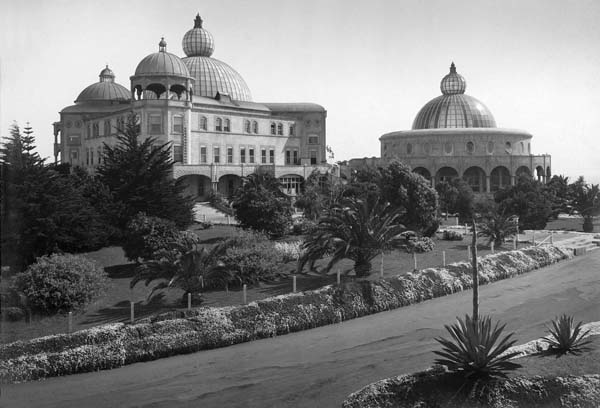
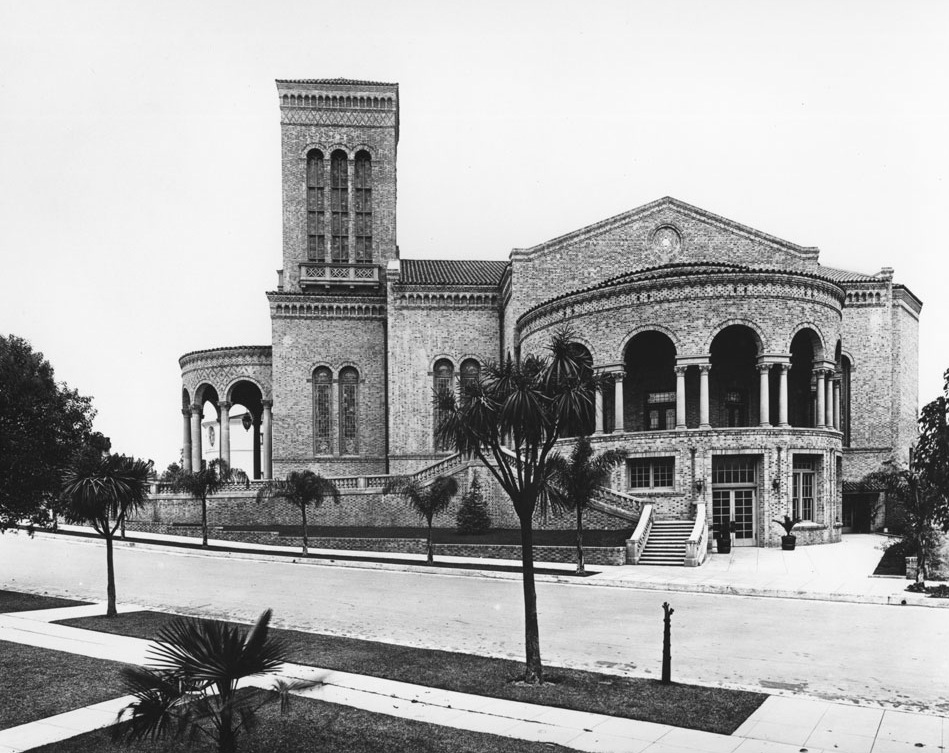

Like many commentators, Sheerin focused on the “abnormal” religiosity he discovered in California, which was symbolic of the lack of religious rigor he thought rampant throughout the West. For example, he declared that New Thought thrived in the West more than the East generally, especially in Denver, San Francisco, and Los Angeles, but not more so than in Boston or New York City. However, he asserted that the “newness is not always so apparent as its disciples assume, nor is it necessarily indigenous to the new California soil.” In the fifth essay, he even chided Western Episcopalian bishops for embracing high church ritualism, such as candles on altars and ritualistic worship. “It is undoubtedly true that the external marks of Churchmanship that came in the wake of the Oxford or Catholic movement are much more prevalent and uniform in the West,” all of which has an “adverse effect on the traveler who prefers less ceremony, and has certainly been a factor in retarding the Church’s growth in the West.” If only the West could be purged of these new religions and the new Anglican ritualism, he argued, then there would be an explosion of religious fervor and Episcopalian preeminence in the West.
 |
| Aimee Semple McPherson, preaching at Angelus Temple. Image source here. |
Returning to his theme of the search for the Holy Grail, he continued: “It was a most natural thing to ask if, after all, this Angelus Temple did not represent the bitter answer to the search for the Holy Grail of Californian life? The churches did not seem much in evidence. Most revivalists had retired in the beauty of their new surroundings. Strange sects seeking some new things were more in evidence than the Christian Church. Here in the midst was a splendid temple, built by a woman, holding thousands, beautiful as the best of churches in its own different way, and packed to the doors day after day by congregations of tourists and local inhabitants eager to hear the messages of a woman whose honest devotion they evidently took for granted.” Pushing against the decline of traditional Christianity that Sheerin perceived in the American West, he located a mecca for up-to-date orthodoxy in McPherson, a bastion of accepted theology and an example of future worship. As many writers have claimed, traditions are reborn in the West, regenerated into new forms that attract new audiences who seek, as Sheerin did, a grail-like, utopian everlasting life.
But, as Sheerin rightly observed, that life comes at a profound cost. While discussing the grandeur of the California mission system, Sheerin reflected at length on the dispossession and genocide accompanying its construction. Perhaps Sheerin’s critique was motivated by his low opinion of high church Anglicanism, rather than a particular vendetta against the Catholic Church itself; regardless, these observations are noteworthy because they document a white Anglo-Saxon Protestant’s censure of imperial religious and territorial expansionism not long after Frederick Jackson Turner declared the frontier closed. Sheerin argued, “No great city has ever been established without wounds and death of the workers, and these California missions included their share of murder, rape and theft and abuse as shameful as in other corners of a barbarous world. There is reason to suspect that much of this went on against the Indians under the eye of a too forgiving monk.” He went on: “Never once did the exalted missionaries lose sight of that royal-military-kingdom idea of the Church, which always held its sword unsheathed, ready to put to slaughter those who refused to be baptized or who became heretics!”
Sheerin linked this violence against Native Americans to the failure of the Catholic church to successfully convert the indigenous population: “There was nothing in the religion of the little man of Assisi that would have made him countenance for a moment a plan that included a body of priests backed by a body of soldiers coming into a land of entire strangers, camping down on their land, indifferent to the rights of its owners, issuing orders to the original inhabitants as if to slaves, and causing them to forfeit the right to existence if they did not accept the secular and spiritual authority of the intruders! No wonder that the religion ultimately failed, that the Indians died of immoral habits and disease, and that within a century every one of the buildings was a ruin, until somewhat resurrected through the sentimental admiration of American Protestants!” Here, Sheerin triply critiques the Catholic Church. First, he criticizes Catholics for harming Native Americans. Second, he argues that the Catholic Church therefore failed to missionize Native American successfully. Third, Sheerin argued that Protestants induced the Catholic Church to renovate its California missions so that it could benefit financially from tourists, even as it profited from the exploited labor of the indigenous population.
 |
| Mission San Juan Capistrano is one of several missions Spanish Franciscans founded in California during the Spanish colonial period. Image via Wikipedia. |
 |
| St. Matthew's Cathedral in Laramie, Wyoming, was constructed between 1892 and 1896. The towers were added in 1916. Photo by McBlobb, via Panoramio. |

In the last essay in the series, he proposed a model that, if it were adopted by church leaders, would lead to church growth in the American West. Sheerin described himself as a “Broad-High Churchman,” meaning that he embraced liberal orthodoxy and missionary evangelism. Therefore, he urged the Episcopal Church to adopt local customs and forgo high church ritualism. Instead, he advised Episcopal leaders to encourage inner devotion, missionary zeal, and “ecclesiastical emancipation.” Pragmatism runs through Sheerin’s approach, one that bends orthodoxy towards greater inclusiveness.
Throughout Sheerin’s articles, he displayed a tendency to equate religiousness with institutional forms, be they church steeples or members in pews. Many scholars continue to embrace this description of religion. Missing from his observations are rich descriptions of peoples’ daily lives, the way they integrated their religion into civic activism, tending the land, or preparing meals at home. Although he focused on the Episcopal Church, the other religions he observed are largely lumped together as “abnormal,” a frequent theme in reporting about religion in the West. When Westerners are not seen as irreligious they are often portrayed as weirdos in Sheerin’s essays; even more recognizably Christian religions like Mormonism and McPherson’s Pentecostal evangelicalism are deviants from “traditional” orthodox Christianity as espoused by mainline Protestants. One would think there must be something in the water, given the way he talked about the mind-expanding qualities of the Pacific Ocean. But Sheerin is not alone; many scholars and other commentators have made similar observations. Hopefully, future scholarship about religion in the American West can push beyond these tropes and into new terrain, discovering new stories and new ways of storytelling heretofore undocumented in the annals of the American West. As Sheerin should have realized, there is no grail at the end of the trail, but only the journey and its tale.
*Publication dates include: November 17, 1923; December 8, 1923; December 15, 1923; February 16, 1924; March 8, 1924; and March 15, 1924. In Barfoot’s bibliography and footnotes, he lists October 10, 1923 as the publication date for the first article in the series, but as far I can tell from the microfiche copies I obtained, part one of the series instead appears in the November 17, 1923 issue.
September 21, 2012
Casual Friday: Chican@ history
This is exciting news!
The Department of Archives and Special Collections, William H. Hannon Library, Loyola Marymount University, has opened to researchers an extensive collection documenting Mexican immigrant and Mexican-American history in Los Angeles. This is the Venegas Family Papers, which consist of correspondence, photographs, immigration records, Roman Catholic realia and devotional literature, and business records, principally related to Miguel (1897-1994) and Dolores (1900-1991) Venegas. The collection guide is on-line at the Online Archive of California.
Themselves Cristeros, the Venegases came to Los Angeles from the Mexican state of Jalisco in 1927 as refugees from the troubles of the Cristero Rebellion (1926-1929). A remarkable run of correspondence from Miguel and Dolores Venegas to relatives in Jalisco from the first five years of their life in Los Angeles (1927-1932) extensively details the challenges and opportunities of their lives as immigrants. The letters offer valuable insights into their work and economic opportunities, family life, recreation, religious practices, diet, health, continued ties with Mexico, and education. Examples of the kind of detail found in the letters include the effects of the Great Depression on the Mexican-American community in Los Angeles and the United States immigration law of 1929.

 |
| A letter from Miguel Venegas to his brother, containing (on p. 2) one of the earliest known uses of the word "chicano." From the William H. Hannon Library tumblr. |
The collection also treats the history of Mexico. The Venegases' correspondence with relatives in Jalisco contains extensive information on commerce, agriculture, health and medicine, family life, and religious practices from the 1920s through the 1940s in Jalisco. Comments by relatives in Guadalajara on the political situation in Jalisco, both before and after the Cristero Rebellion, are especially valuable for understanding the course of the Cristero Rebellion and its aftermath. Cristero "corridos" (ballads) provide a valuable source for understanding the culture of the Cristero movement.
Photographs in the collection record the social activities and work of this LA family. Noteworthy are those of Venegas family outings to Lincoln Park and the beach in the late 1920s, which provide photographic documentation of the social life of Mexican immigrants in Los Angeles at that time. In addition, there is a strong run of photographs of Guadalajara and Zapotlanejo, in Jalisco, which document work, family life and religious culture, e.g. vacations, masses, and work on a hacienda.
Subscribe to:
Posts (Atom)